My Turkeys - The Next Chapter
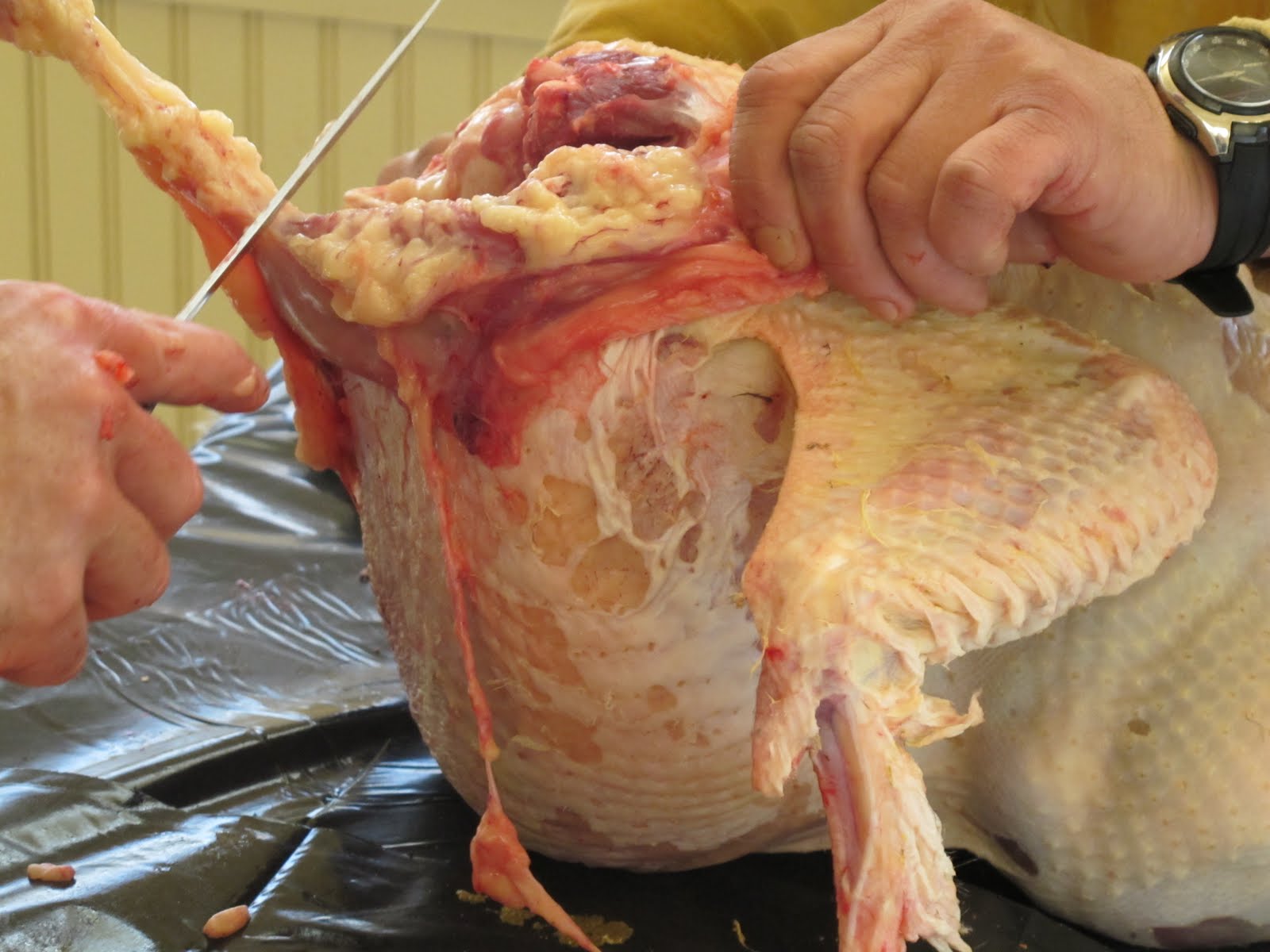
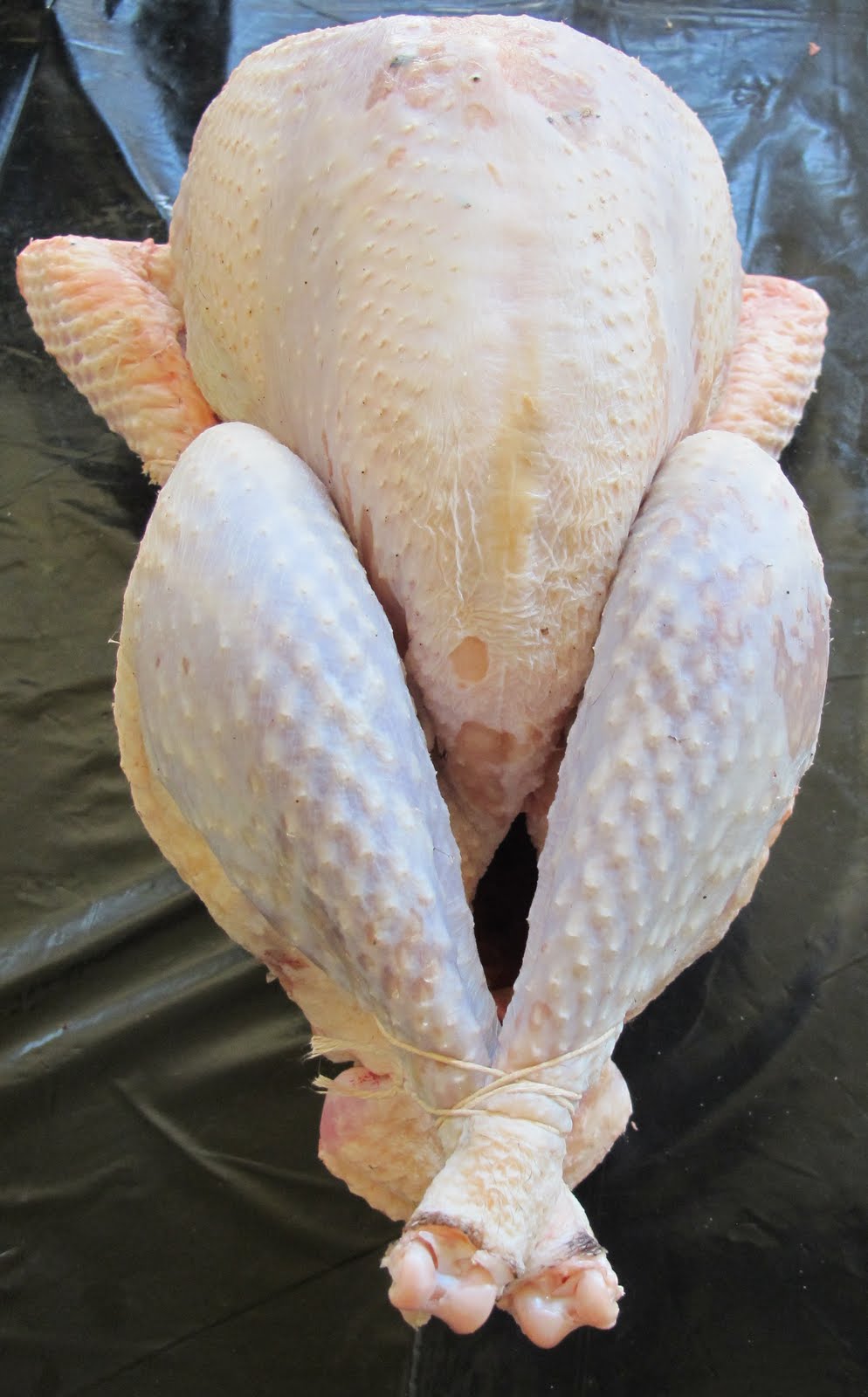
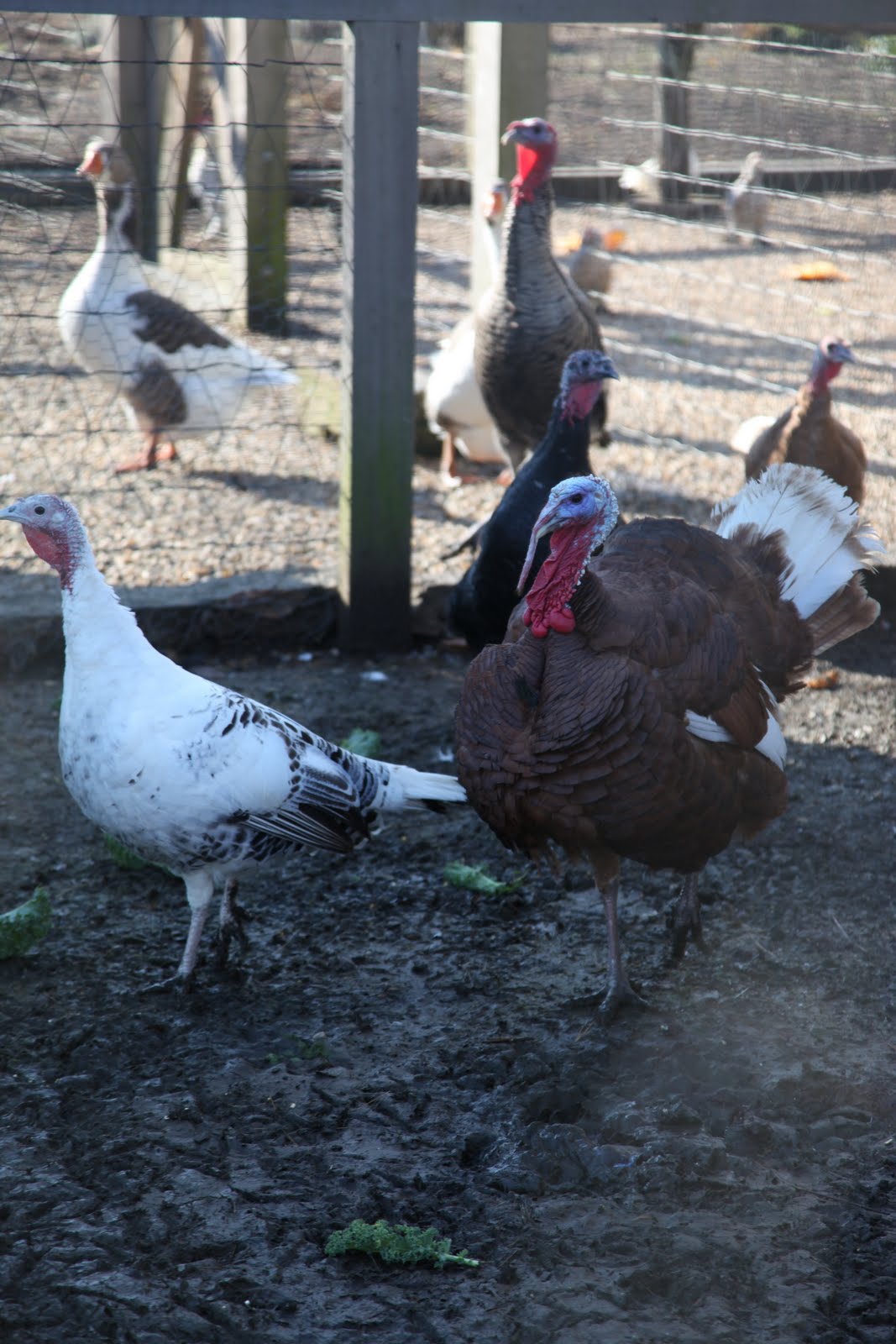
As you may know, I have a penchant for backyard animal husbandry, the agricultural practice of breeding and raising livestock. Since I have a farm, I believe in raising one’s food and being as humane as possible in the treatment of that food. I also have a great appreciation of good food and prefer eating better tasting and better for you heritage breeds of livestock. You may recall that last August, I acquired beautiful heritage breed turkeys, including Bourbon Red, Royal Palm, and Black Spanish. I found out, however, that the timing was all wrong. The turkeys were too small to butcher last Thanksgiving and they would be too tough to eat if we waited until next Thanksgiving. Turkeys also have difficulty walking when they get too large. To make room for a new brood of turkeys better suited for Thanksgiving, I asked my friend Chef Pierre Schaedelin to help.
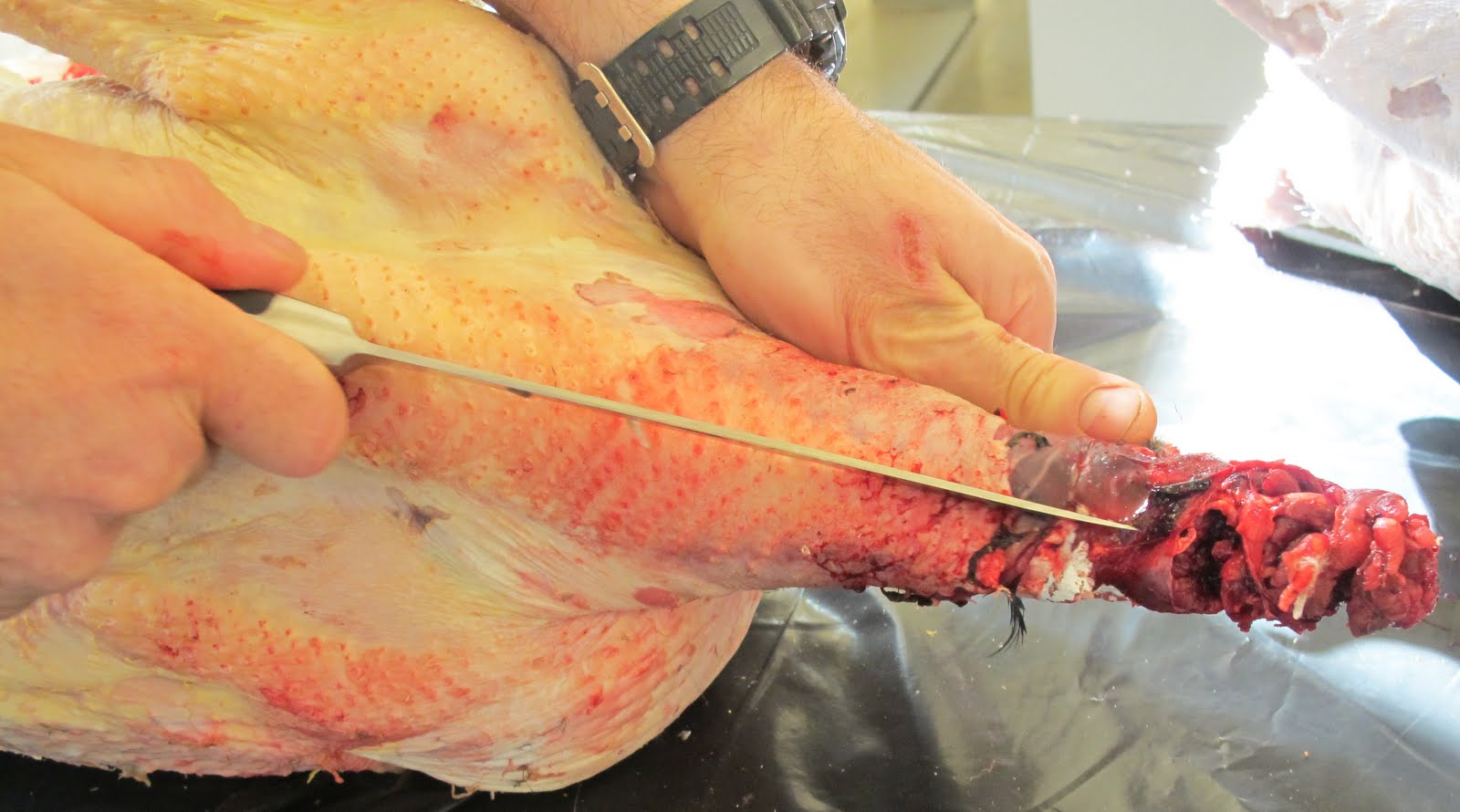
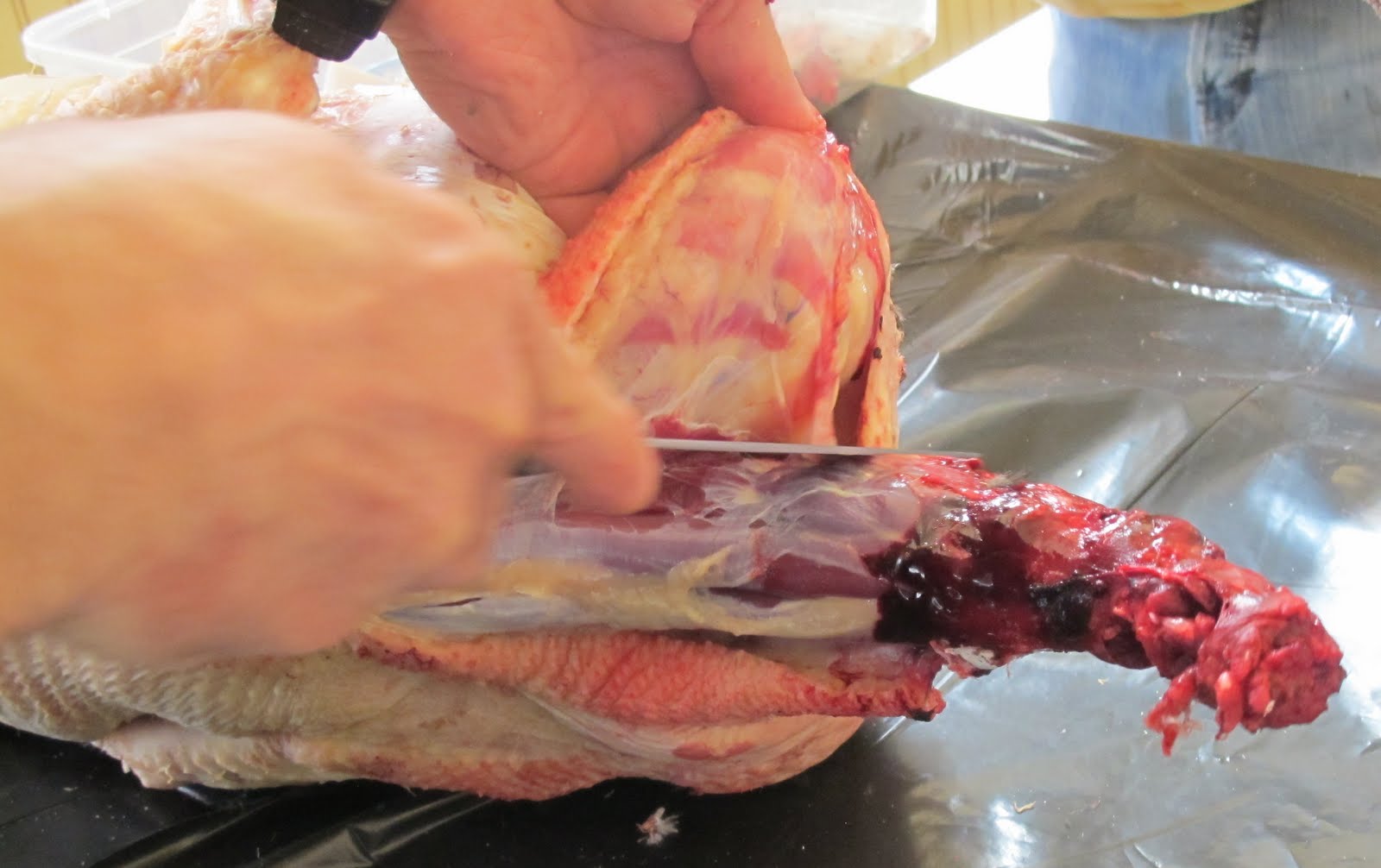
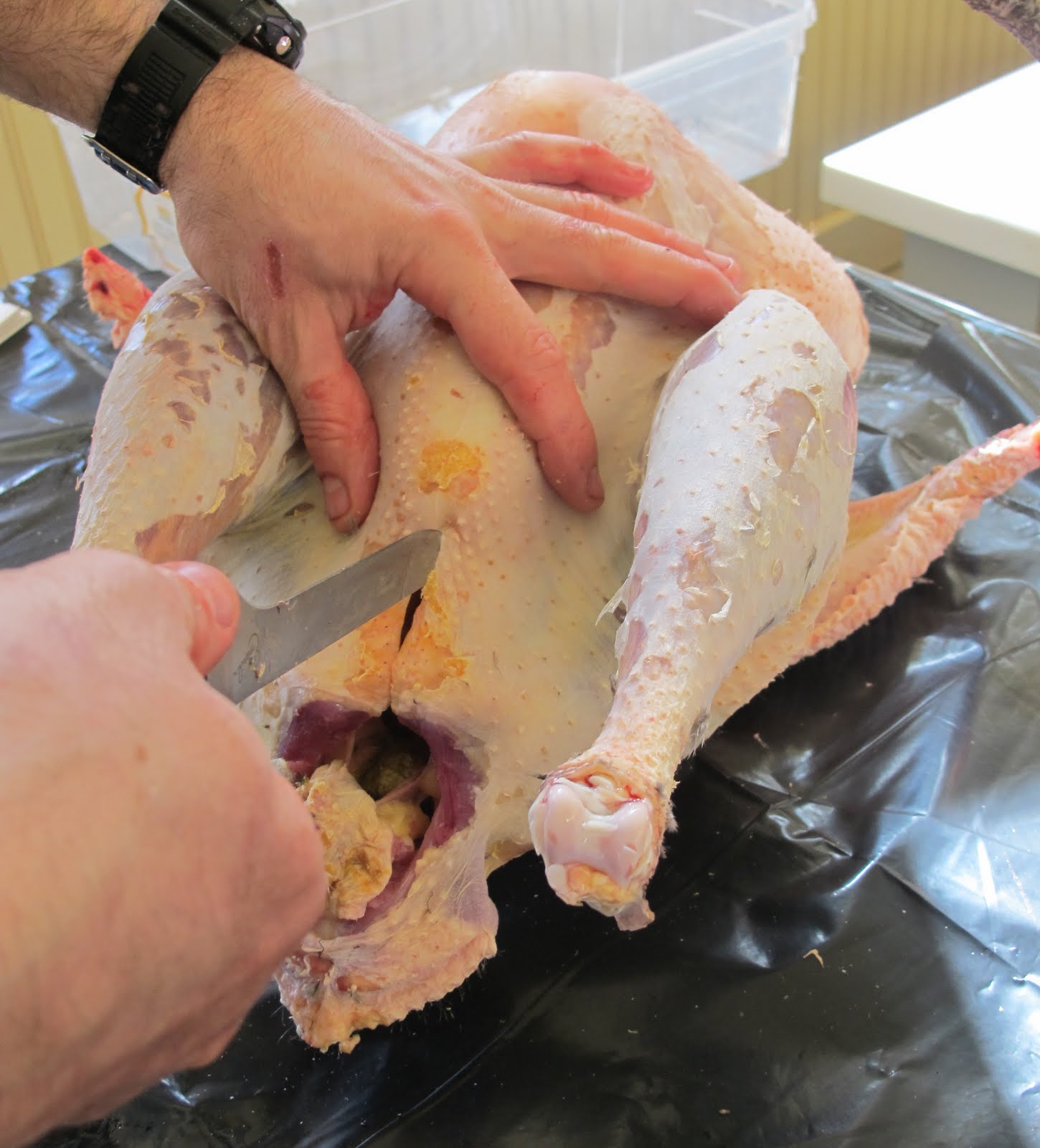
Pierre is from Alsace, France near the German border. He recalls that when he was a child, most families in his surrounding area, grew their own fruits and vegetables, and raised and butchered their own livestock. The social life in Alsace revolved around food and respect for it, and neighbors shared wonderful meals with one another. I know many of you may find this blog especially graphic, but it’s all part of the circle of life and knowing and understanding what you eat.
1 These heritage breed turkeys were fed a great diet and were able to wander free-range throughout the day.
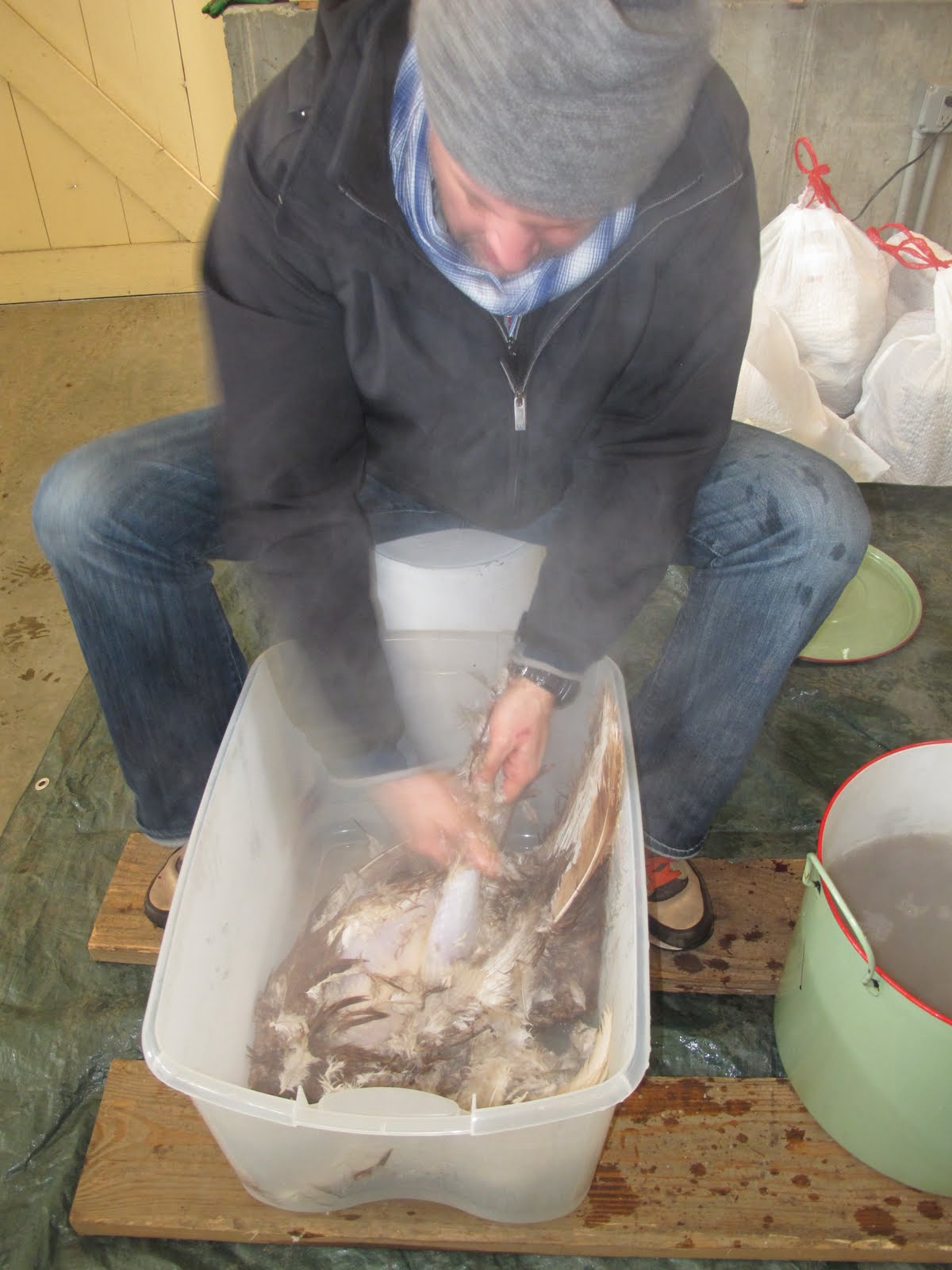
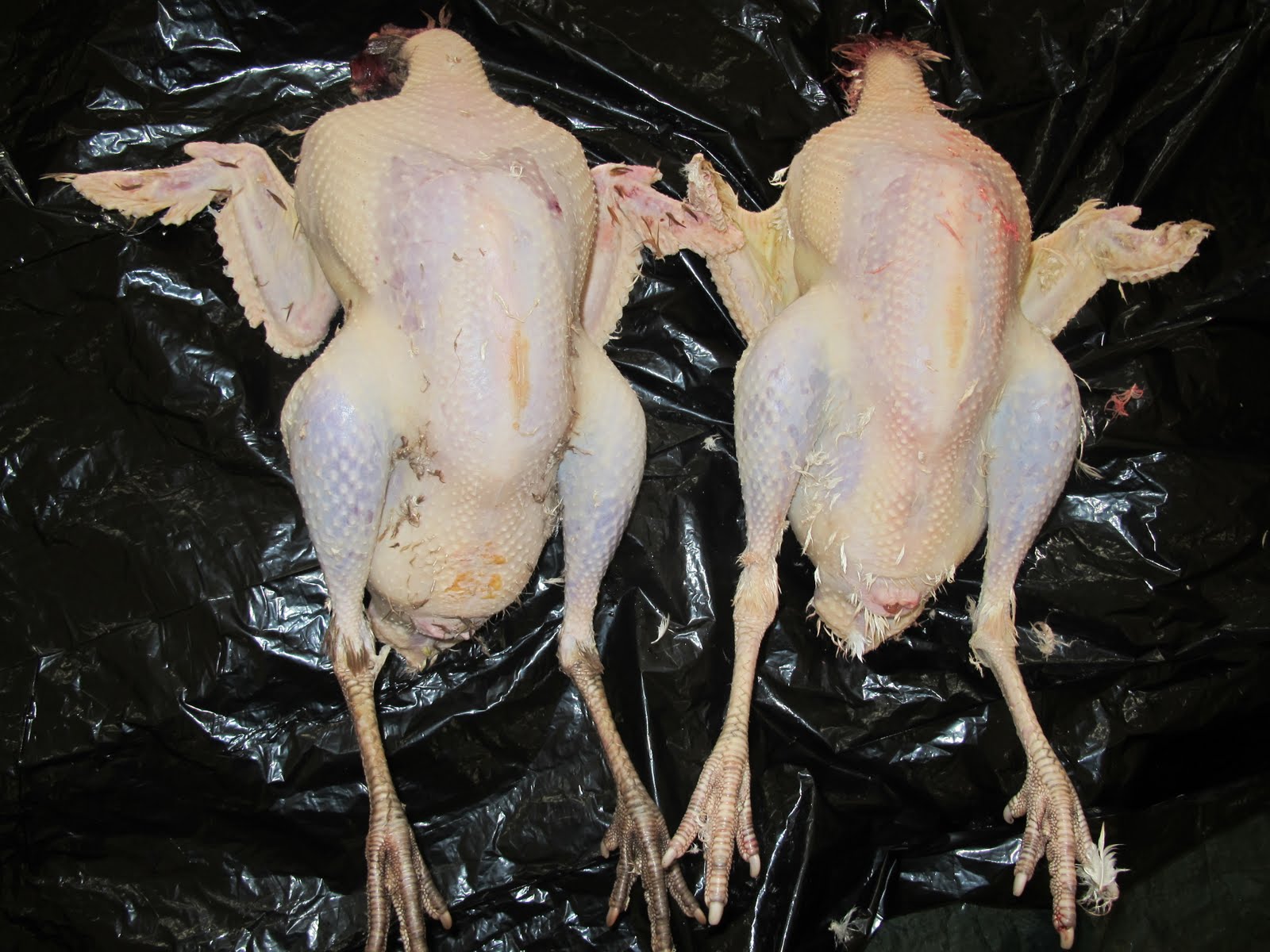
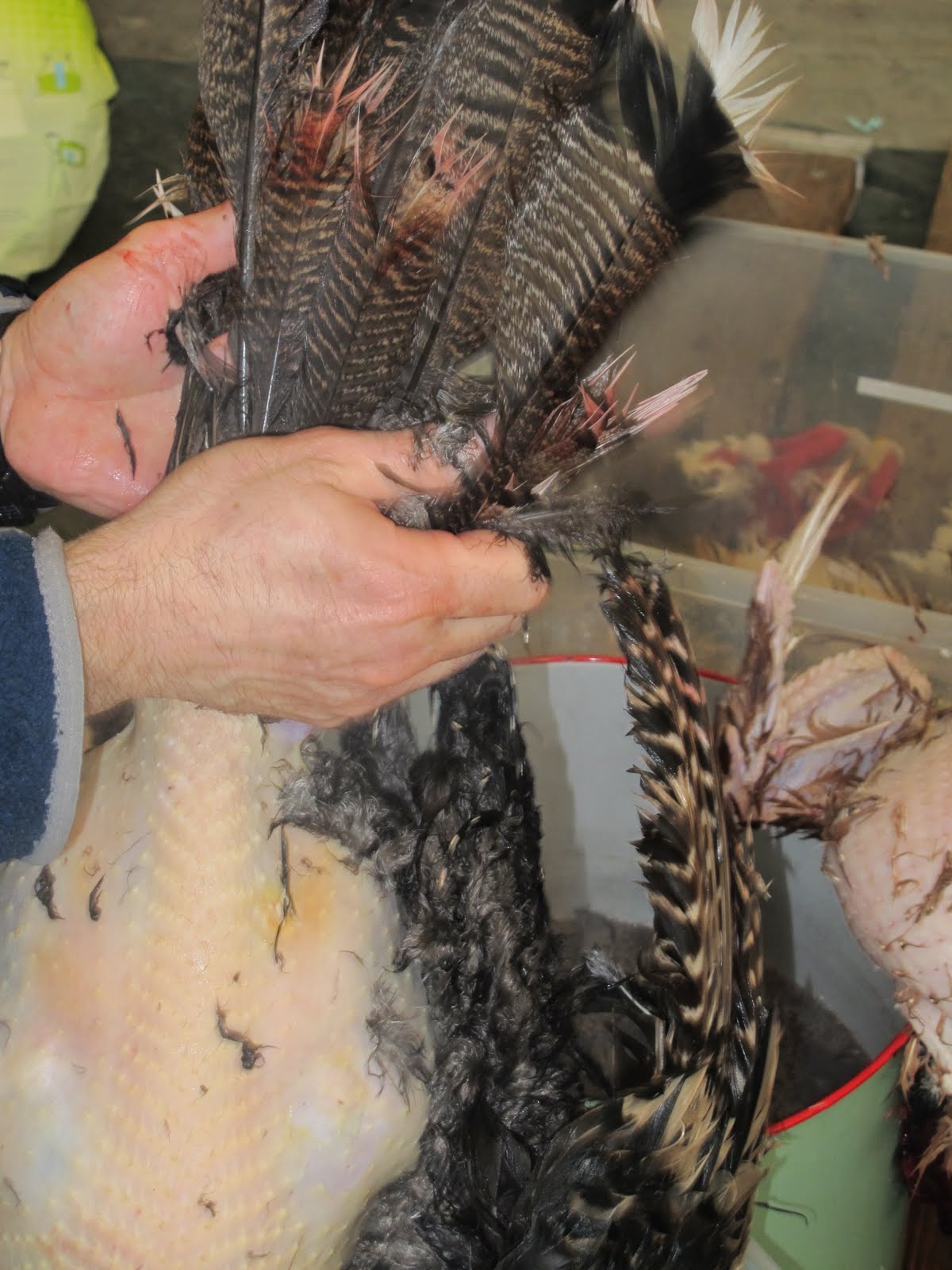
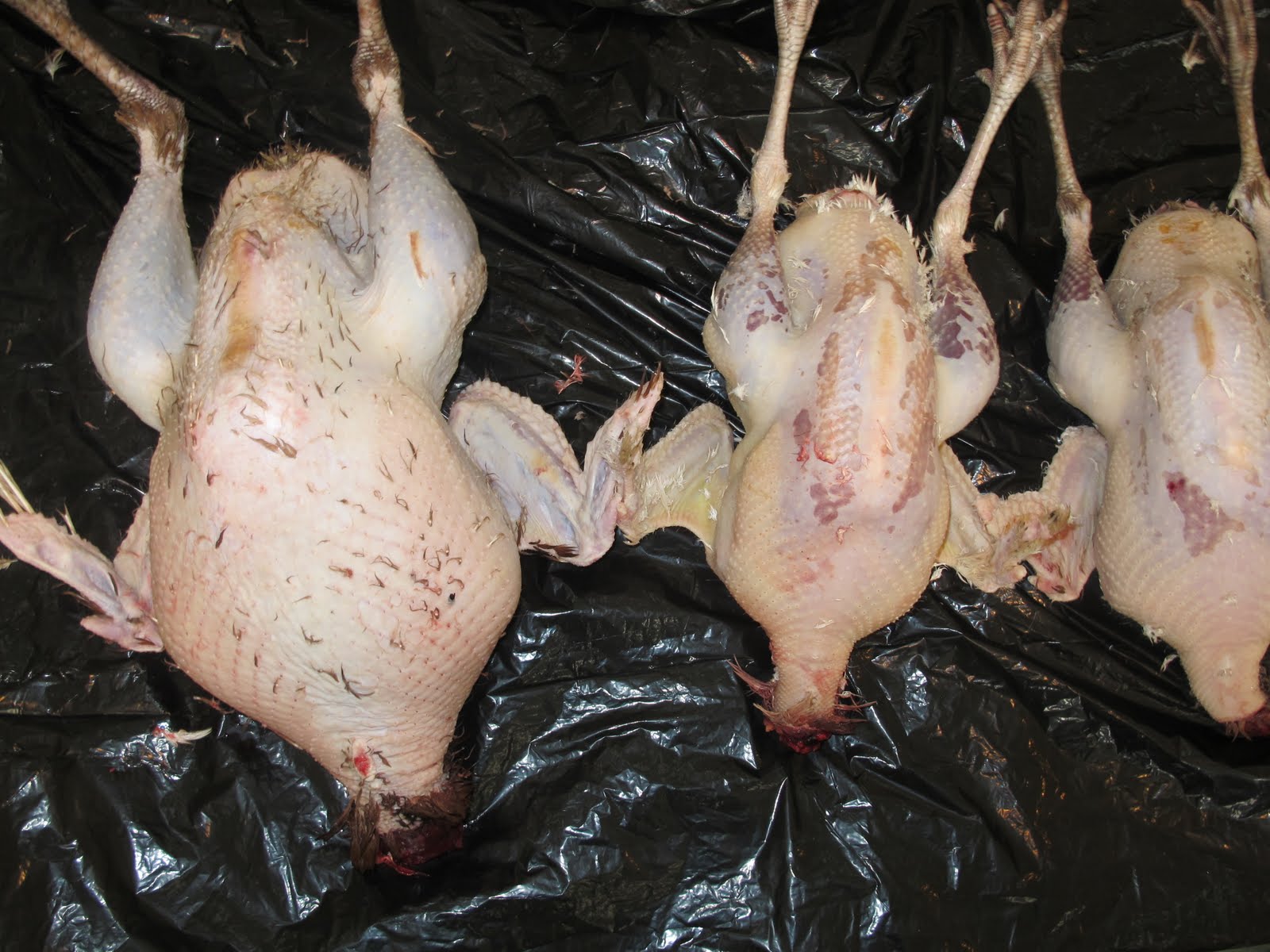
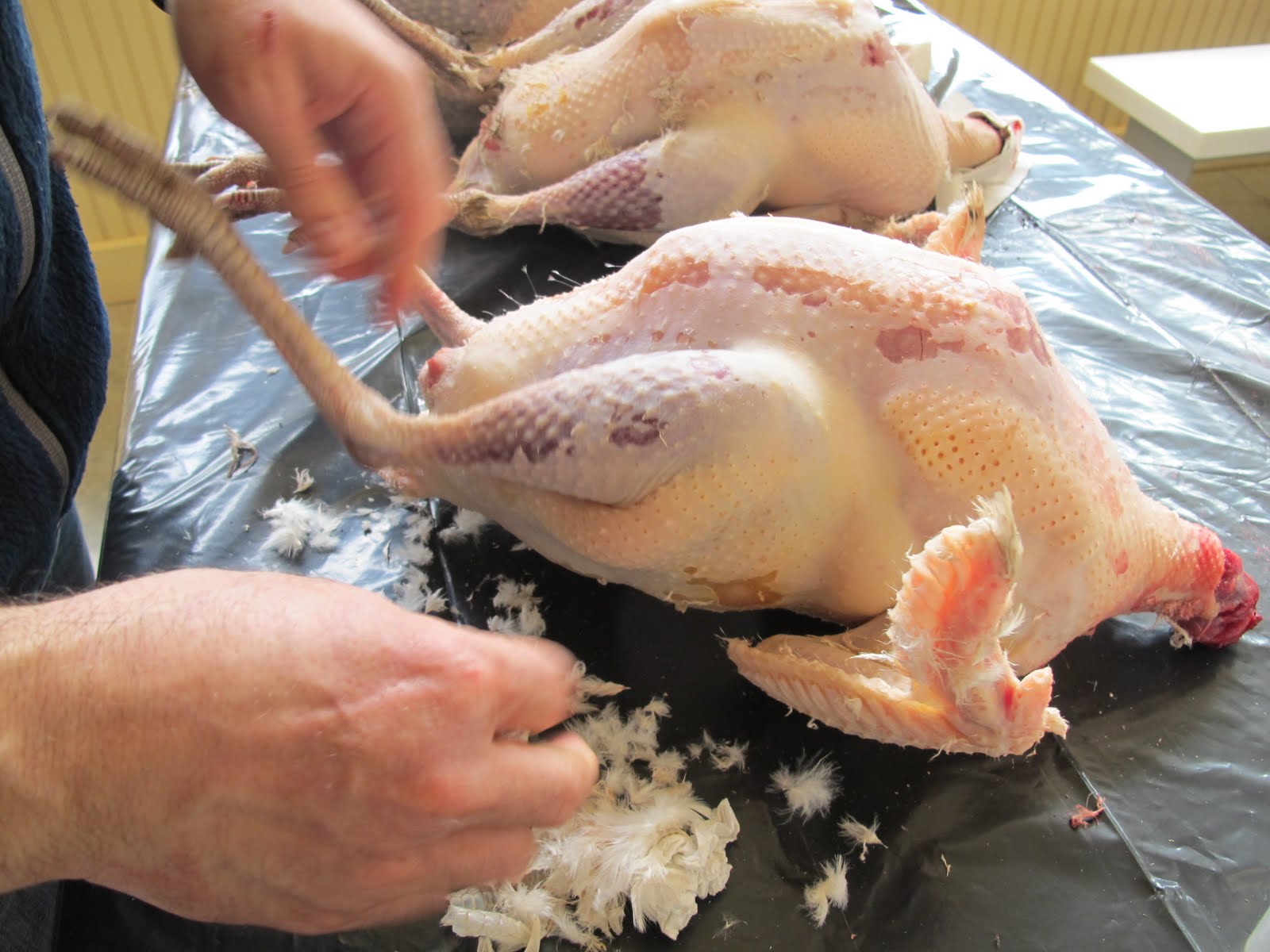
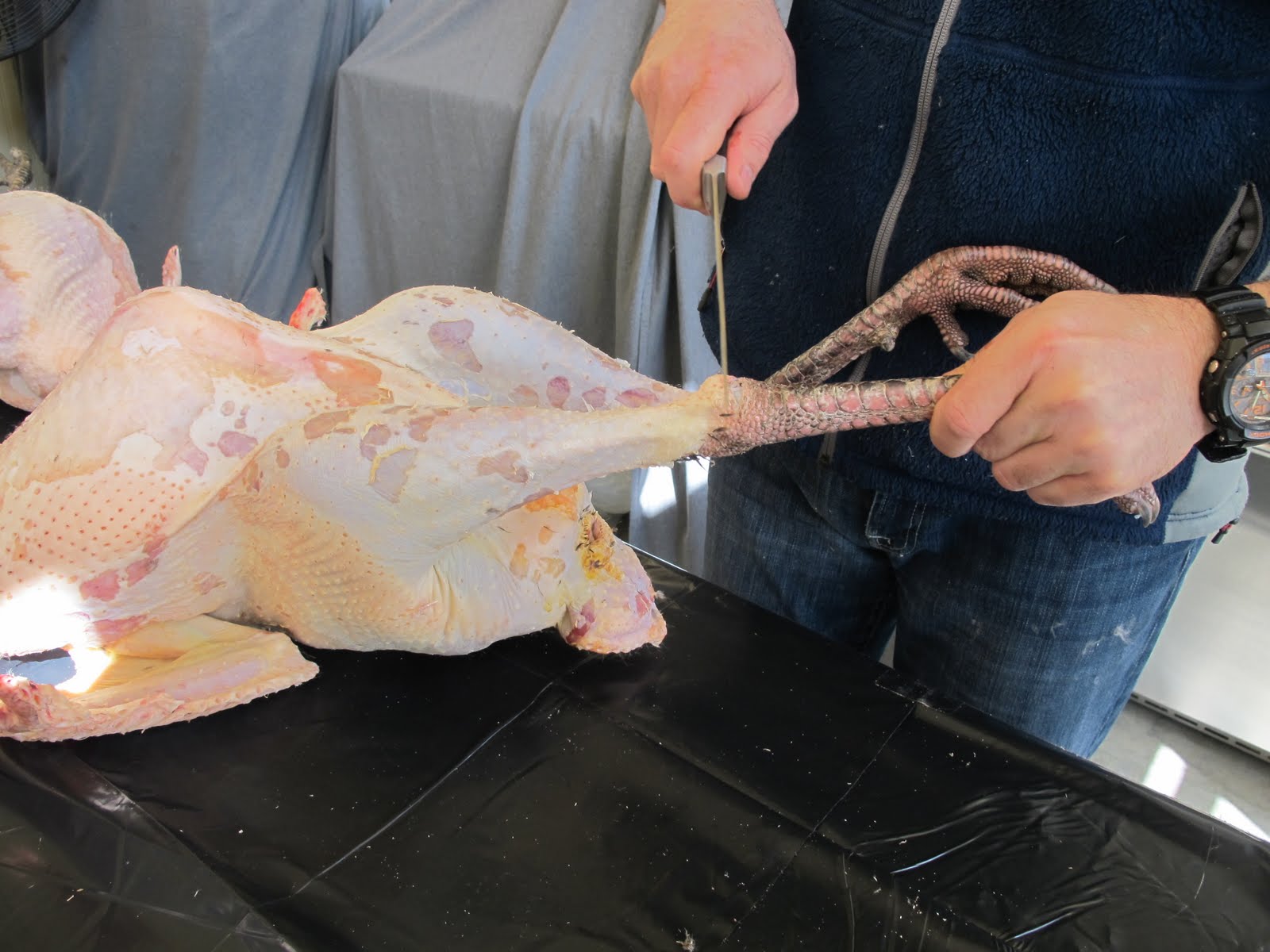
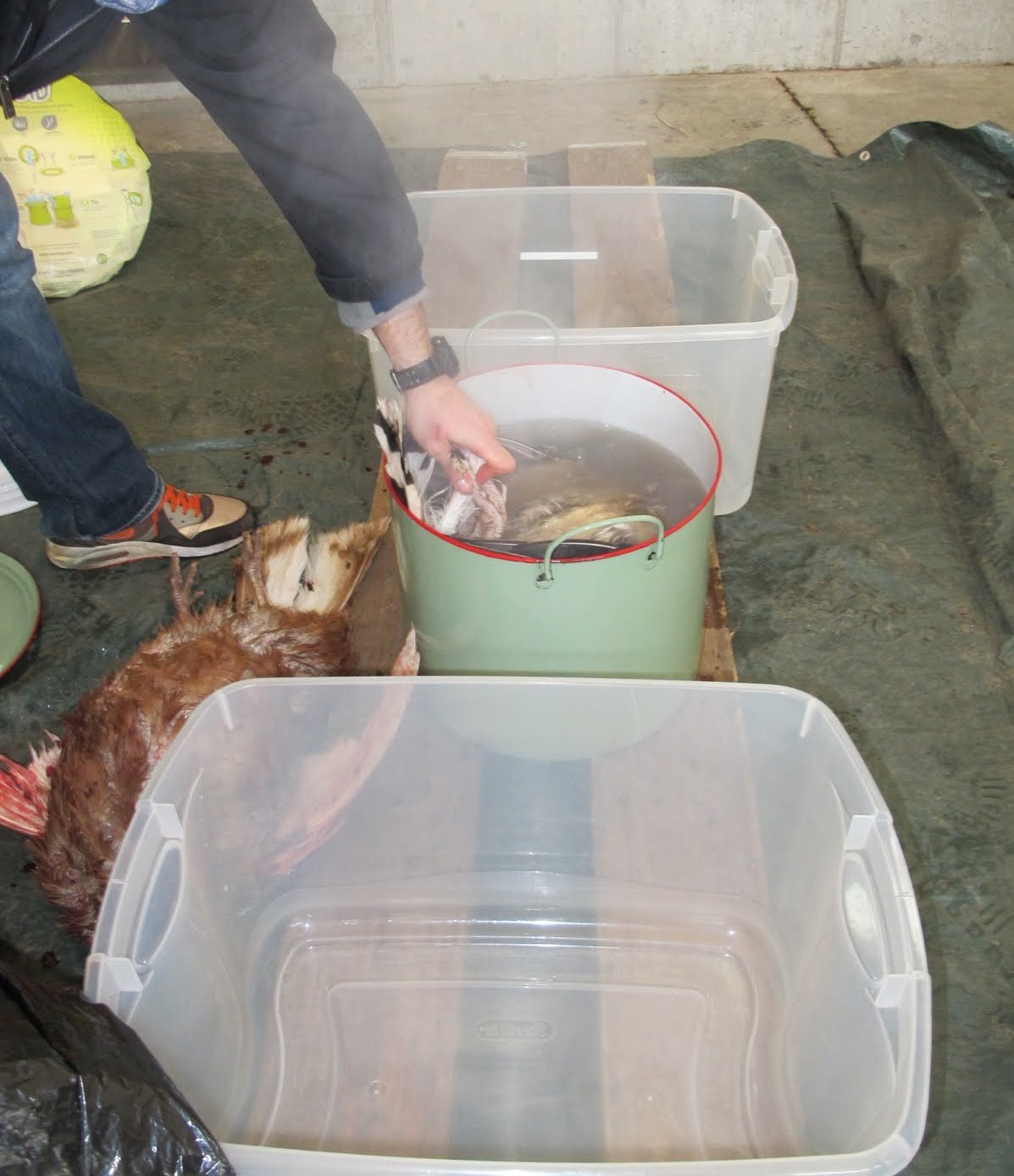
2 Because it was so cold outside, Pierre set up an area in the equipment barn where he removed the feathers.
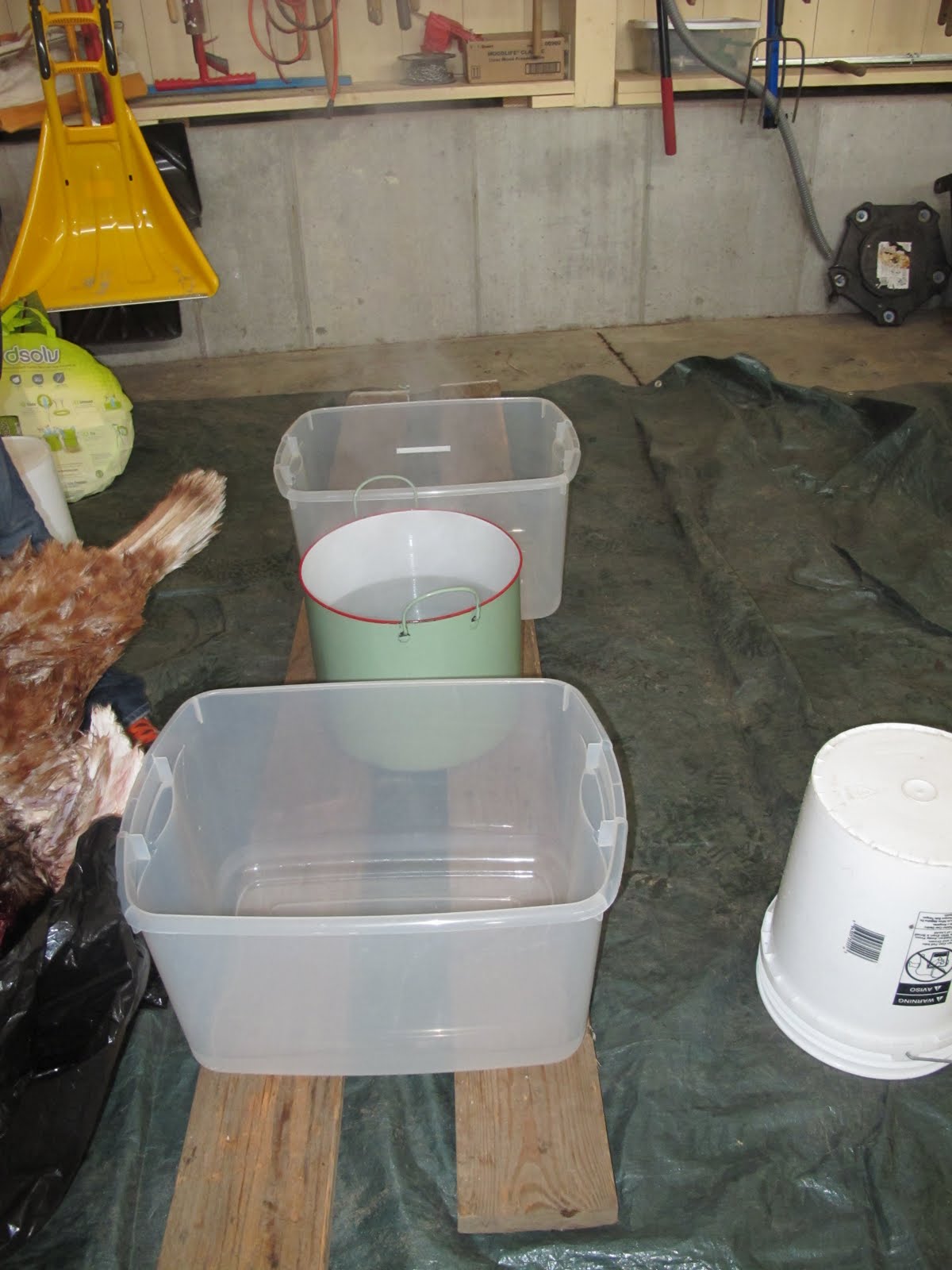
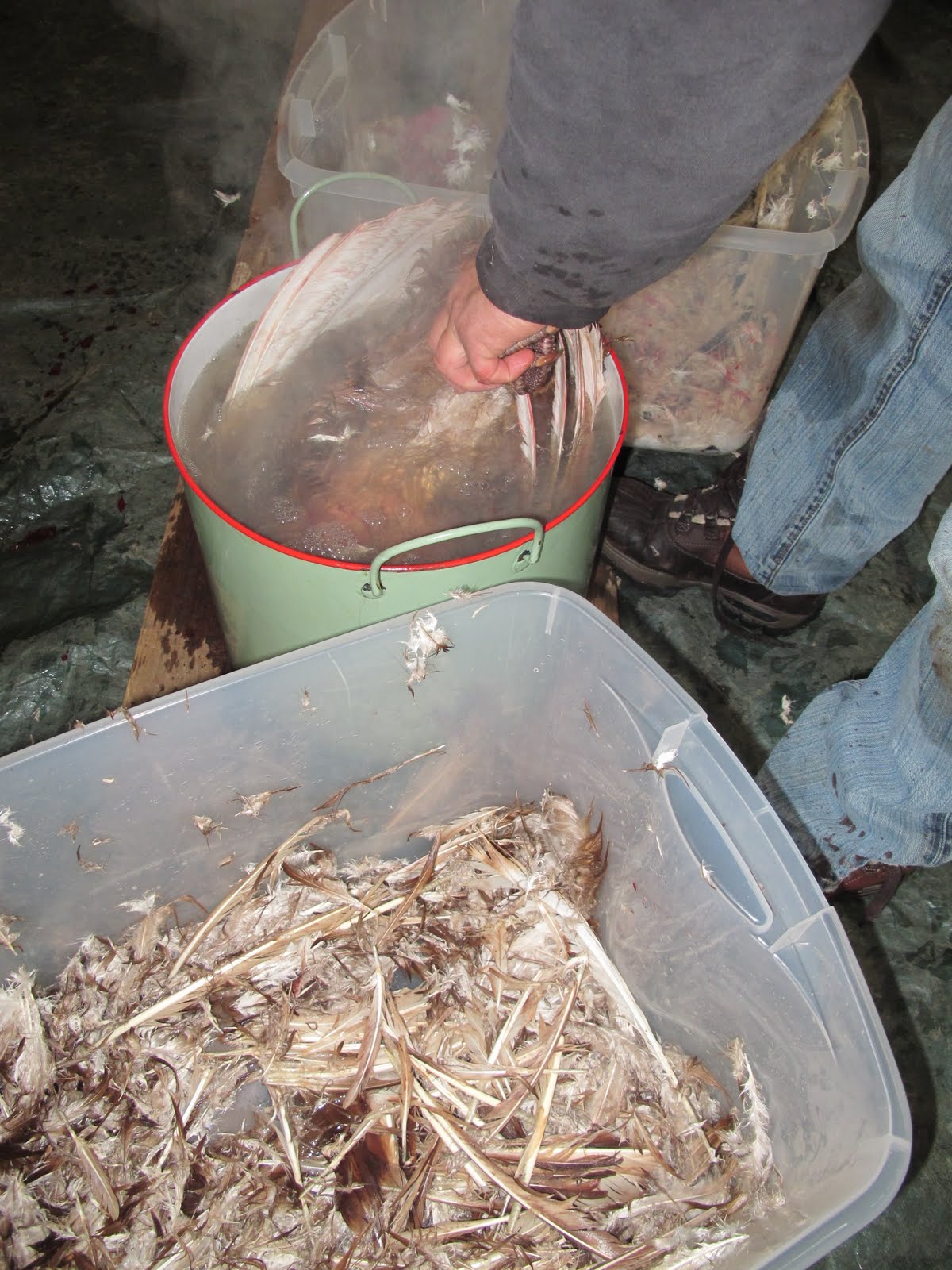
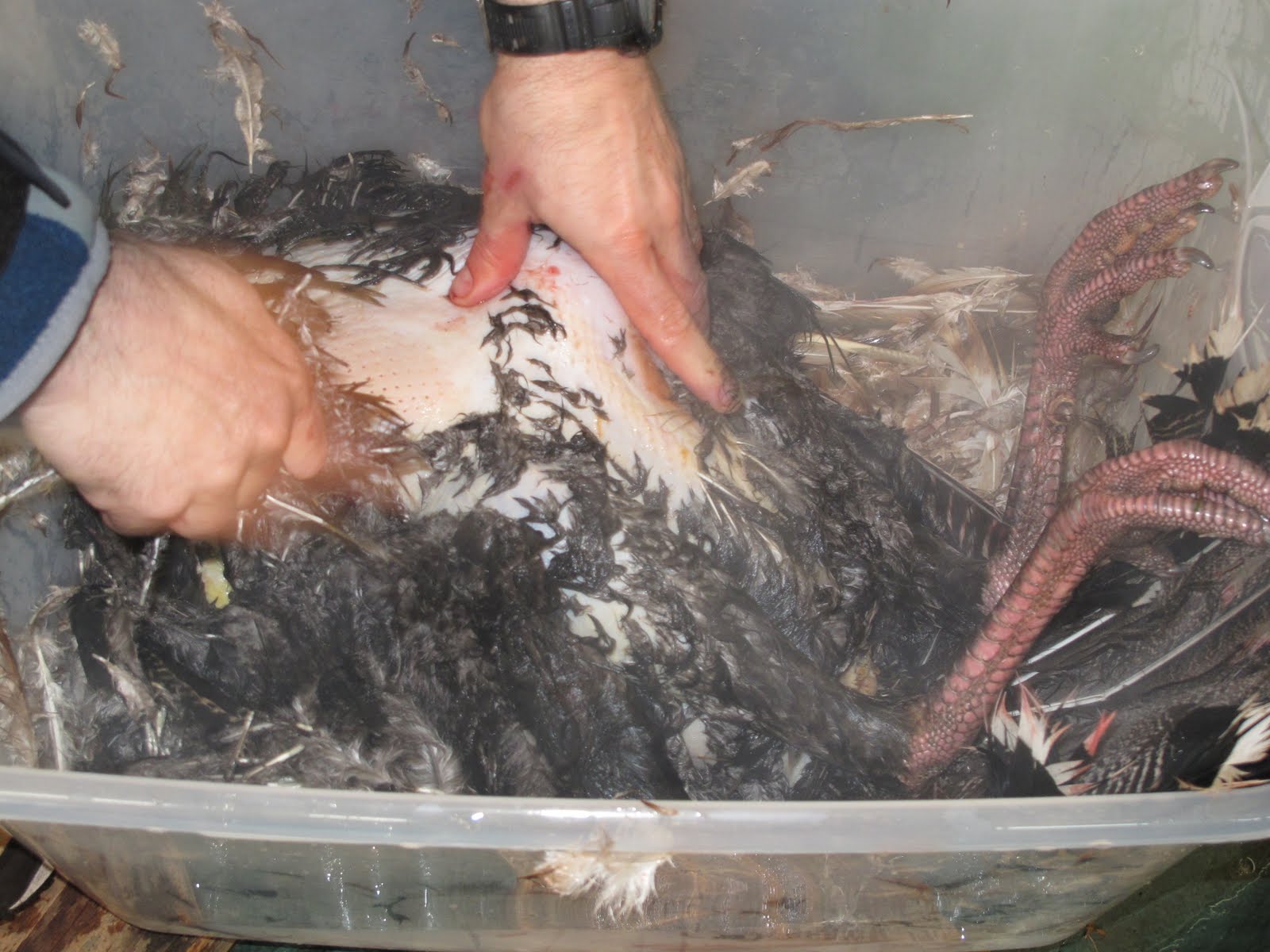
3 The first step is to immerse the deceased turkey in nearly boiling water for 30 - 45 seconds. This opens the pores, making the plucking easier.
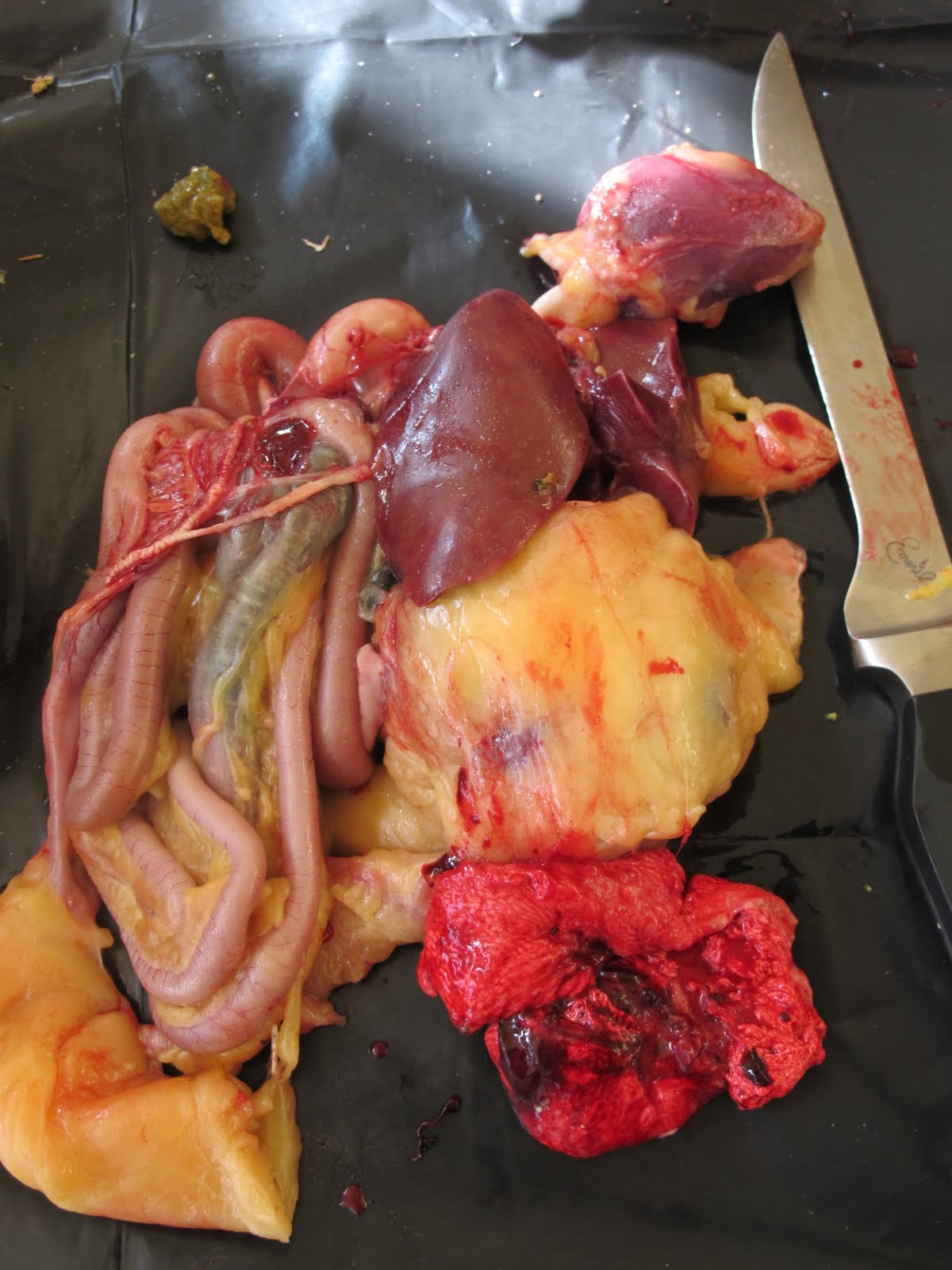
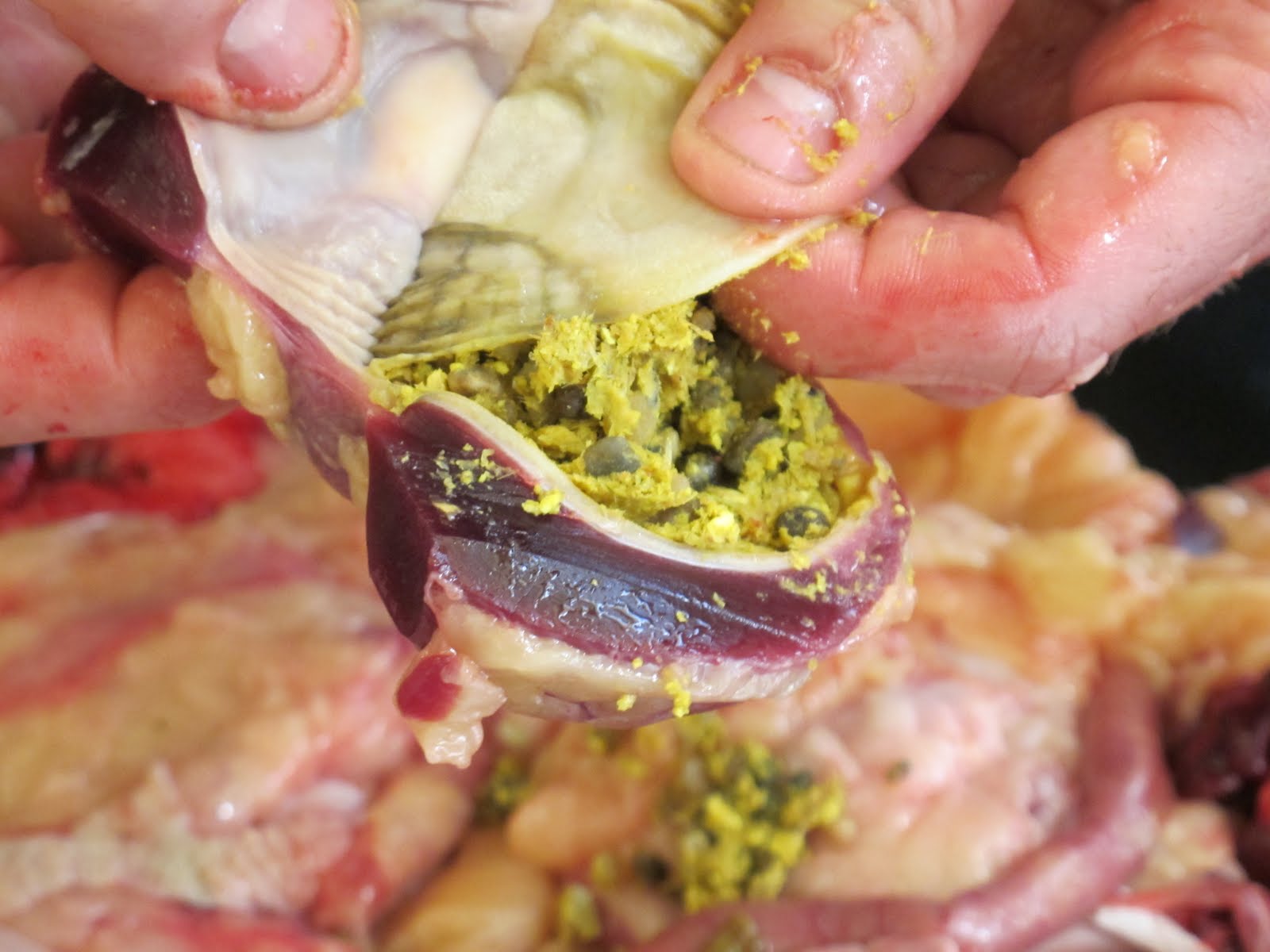
19 Removing the inside wall and contents of the gizzard - a specialized stomach constructed of thick, muscular walls, used for grinding up food. As you can see here, small stones have been ingested to help with the process.
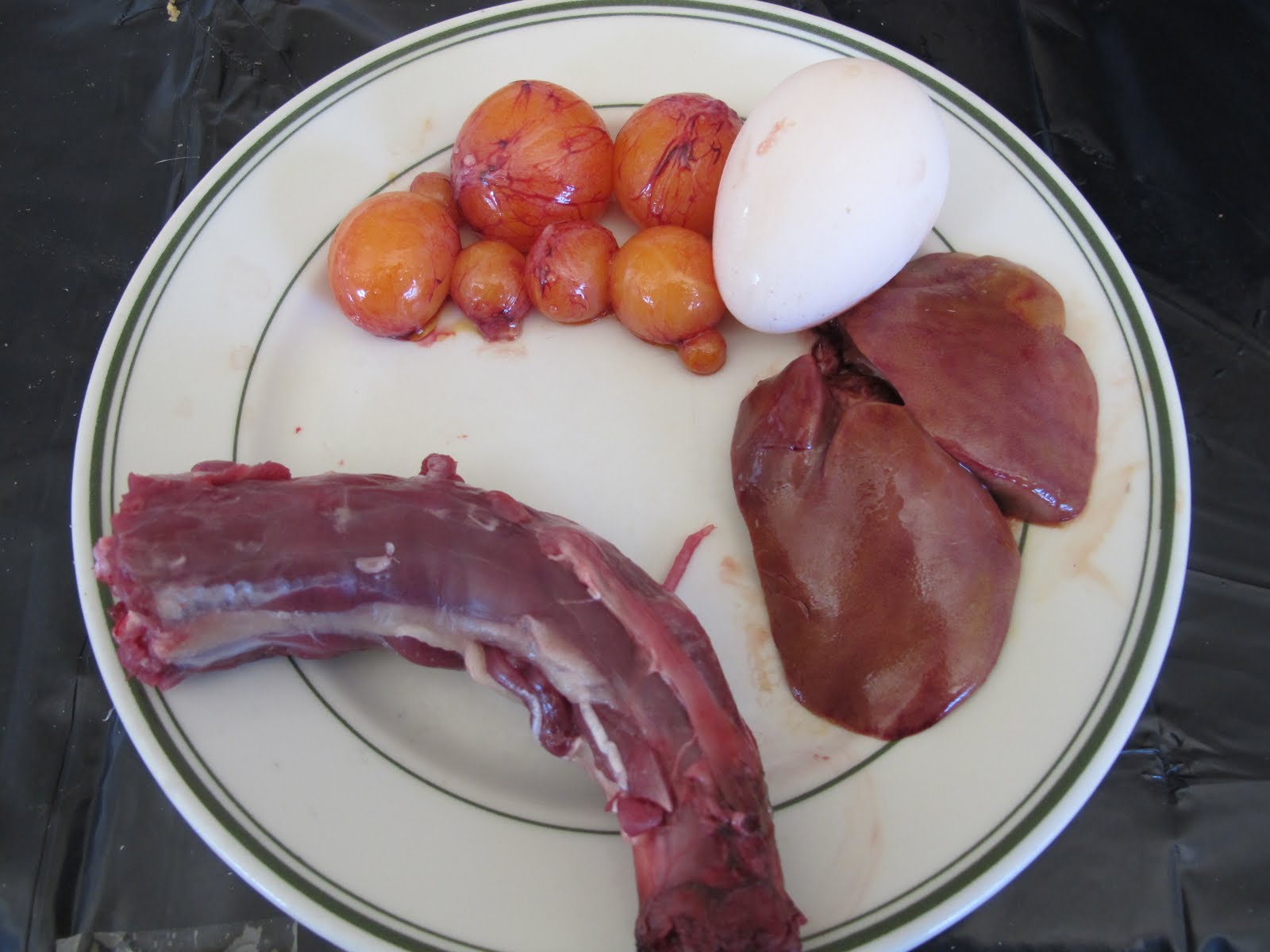
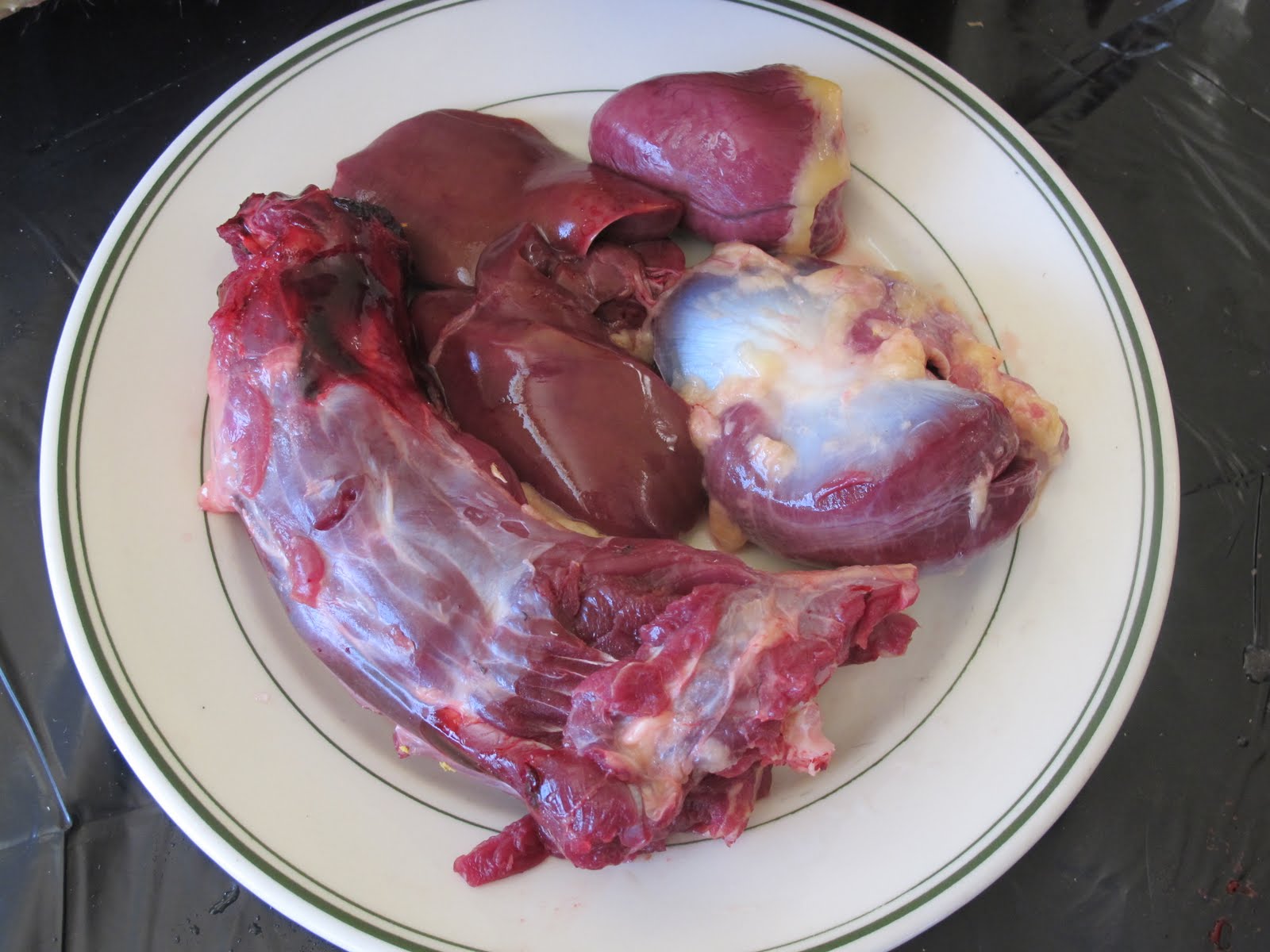
20 This is what you receive when you purchase a ready-to-eat turkey or chicken - the neck, the liver, the gizzard, and the heart.


As many chickens as I've helped butcher in my life-time, I've never seen yolks like that. Is it only turkeys that do that, or do chickens have them as well?
Very intersting!!
Gloria G!!
Posted by: Gloria | March 30th, 2011 at 12:13 am
This was fascinating. It was respectful and as with all things Martha Stewart - I learned a few things today.
For anyone who might be squeamish - I'd ask them: "What did you have for lunch today?"
We need to be more connected to our food - from growing it as a vegetable to growing it as a live animal.
Thanks for sharing Martha. It made me think.
Posted by: stephanie | March 30th, 2011 at 2:34 am
i eat meat, a lot less than i used to. if all the meat options at my local store are results of factory farming, i just rather figure our a vegetarian dish to cook. my father hunts so i have been very lucky to have had access to fine meats, while been made aware what happens to the animal before its the meat goes into the kitchen.
thank you for showing what needs to be done before meat is ready for consumption. i think the slaughtering part is equally important, however, that might have crossed the line with a lot more people than what you showed did.
Posted by: liisamarja | March 30th, 2011 at 3:29 am
Once again, so totally fascinating. I just love these blogs each morning.
Posted by: Gwen | March 30th, 2011 at 5:45 am
Thank you Martha. I have learned so much from Farm Forward and I appreciate your work. It will help and heal the world when we all have a better understanding of the poison of Factory Farming.
Posted by: Sabrina Jansen | April 4th, 2011 at 1:22 am
This is absolutely fascinating!
Posted by: Amanda | April 4th, 2011 at 1:51 am
I'm so pleased that you put this post back up. It is fascinating to see.
Posted by: Perfecting Pru | April 4th, 2011 at 3:44 am
Oh my this blog made it back. It was posted last week the same day as the Vegan Show but was removed before I could push send with my comment.
Educational? yes and yes Stephanie I'm one of those "squeamish" people and haven't had had a piece of meat in my mouth since then. I watched a show a few years back on slaughter houses that made me totally sick and it was over 4 years before I got rid of the lump in my throat.
I wouldn't make a good farmer. If I had to go out and feed the animals they would feel like my pets and I could never eat them. And the idea of me being a dog breeder would never happen. I'd become so attached to those puppies that I could never sell them.
So for now I'll stick with my meatless dishes hopefully this will pass.
Posted by: Ann | April 4th, 2011 at 6:53 am
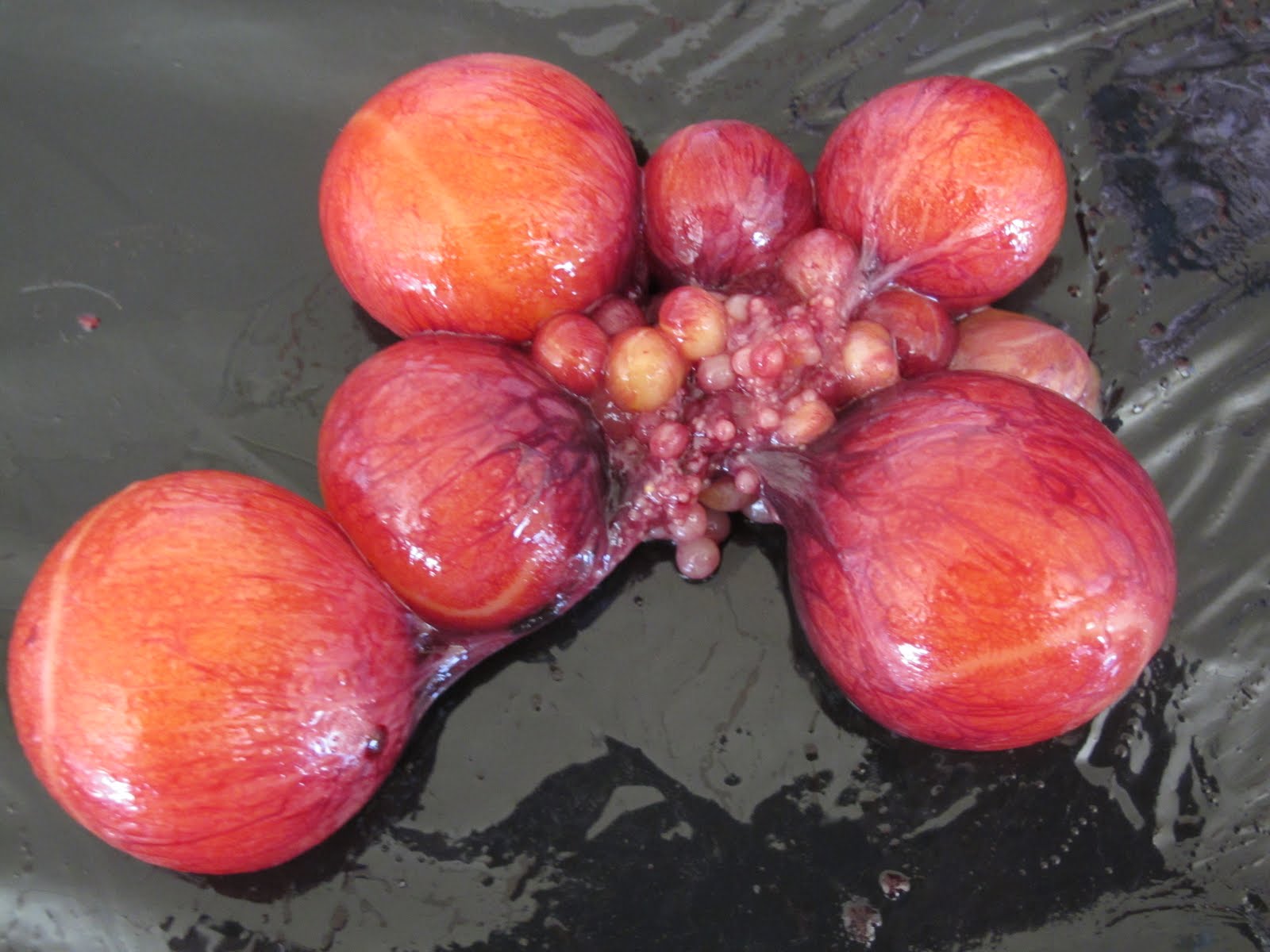
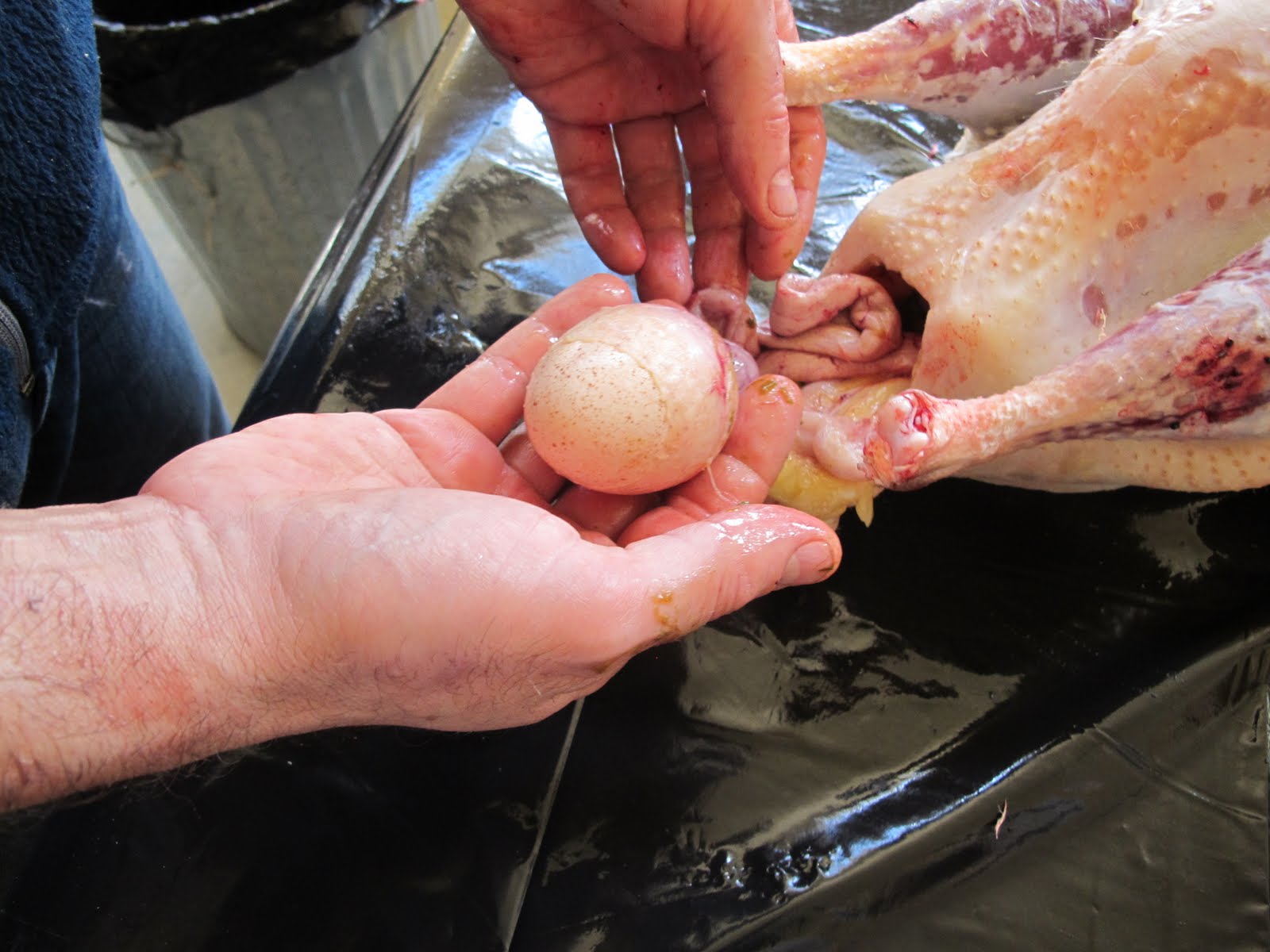
This was fascinating, thank you for showing it. Especially interesting were the photos of the unlaid eggs and yolk sacs--something I hadn't thought about before.
Posted by: maria | April 4th, 2011 at 7:16 am
Pierre is so cool! This was a great post.
Posted by: Jessica Van Nuys | April 4th, 2011 at 8:11 am
Love you Martha, but I had to skip this one.
Posted by: Janette@The2Seasons | April 4th, 2011 at 9:07 am
Very interesting post. Years ago I worked in the art department at Outdoor Life magazine (one of many mags I worked at), and we frequently ran articles on dressing deer, bear, etc. It is a fascinating process, one that not many people are familiar with. It really brings about thoughts of our early ancestors and the rigors of getting a meal together. Nothing packaged, everything fresh and from the earth. Thanks for sharing.
Posted by: Al | April 4th, 2011 at 9:17 am
Hi Martha,
I get squeamish looking at a cut on my finger so of course anything of this nature makes me squeamish but it doesn’t stop me from eating meat that was provided for us. My aunt and uncle who lived in Canada raised their own chickens, pigs and turkeys and they were treated humanely and I ate them with no problem. I never wanted to watch fowl being slaughtered but I did help pluck feathers and what a job that was. My cousins were more adept but like Pierre, they were raised on the farm. This was a fascinating blog and I don’t believe I’ve ever seen yolks like the ones you pictured. Trish
~
P.S. I spotted you on TV at the Yankees game and took some freeze-shot pictures – check your emails.
Posted by: Trish | April 4th, 2011 at 9:38 am
This is very interesting and educational. I agree that it is better that you have your own farm with fruits, vegetables and animals which you can raise on your own. Because of it, you are sure that what you eat is healthy and we know where it came from.
Posted by: Jupiter Blue | April 4th, 2011 at 9:53 am
Hi Martha, Thanks for reposting this fascinating blog about your farm turkeys. I commented about it on your March 30th blog when it was replaced by your blog about the event you had for collect money to help the Japanese after that horrific earthquake and tsunami. What would you ever do without fantastic Pierre who is extremely talented just like you?!! I always wondered how the feathers were removed and he sure did show us some terrific techniques to get the turkey cleaned up so well! Thanks again for helping us learn something new! Can't wait to see your TV Show, Martha Bakes, and to hear you on Sirius Radio 112. On my way to see what Francesca and Sharkey are up to today in the stable with Betsy on The Daily Wag! Have a great day! Jan
Posted by: Jan Erickson | April 4th, 2011 at 10:26 am
Martha That was a great post. Getting ready too do our Black Spanish Turkeys for the first time here, to small last fall. I bet you can't wait to try them.
Posted by: David Iddles | April 4th, 2011 at 10:44 am
Martha, that's a little graphic for me. Thanks for sharing this blog.
Posted by: KLBrown | April 4th, 2011 at 11:01 am
I, like Maria, was fascinated by the unlaid egg and the yolks. My Grandma & Mom never told me about that part! By the time I was born, my Grandma was done plucking poultry. Grandpa had even stopped pheasant & duck hunting. I was used to skinning rabbits & raccoons and cleaning fish with Grandpa.
Posted by: Sharon | April 4th, 2011 at 11:23 am
Yes, it's graphic but i remember my grandparents processing their chickens in similar fashion. The egg yolks look like eyeball images on the computer screen one sees during an eye appointment.
Posted by: sherey | April 4th, 2011 at 11:51 am
Martha -
You really are a true teacher. Yes, this was graphic, but necessary and very interesting. I pride myself on using your Turkey and Stuffing 101 recipes each Thanksgiving and I always get beautiful results. This post adds so much more value to those and I so appreciate it.
Posted by: Gary | April 4th, 2011 at 12:08 pm
I think that the taste swift co louisville is superb, yet they process thousands of swine per day.
Posted by: Chris gorney | April 4th, 2011 at 12:10 pm
We are homeschoolers. We have done mammal dissection but no birds. This was very educational. My older son had some great questions. My younger son told me all about the gizzard. I guess he's been listening to his brother's lessons.
Thanks for the pictures.
Posted by: Lisa | April 4th, 2011 at 12:15 pm
Thank you for showing this! I remember back when I was a child that Chicken Butchering Day was always a big day on my Grandma's farm. It brought back so many wonderful memories of being raised on a farm. I lived on a farm where my dad only was a crop farmer. Down the road is where my grandparents lived and they had all of the livestock. I remember all of the wonderful meals from fresh produce and livestock. There's nothing in the world like it!!!
Posted by: Cassandra Tinder | April 4th, 2011 at 12:54 pm
Fascinating! Thank you for sharing. This is way less graphic than what you'd read if you learned how regular turkeys are factory farmed and slaughtered.
Posted by: Penelope Bartell | April 4th, 2011 at 1:01 pm
very interesting, showing what needs to be done before the meat is ready for consumption.I have learned so much from this post.This was fascinating.Thank you Martha.
Posted by: eidyjoan | April 4th, 2011 at 1:07 pm
I find it absolutely astonishing that some people actually find these pictures fascinating... Thats so like most americans... consume consume consume and never ever occurs a single thought on what is consumed and how it all works i.e. the process of it all... THis is something most europeans know and have all seen... And it shouldnt be strange, fascinating or "to graphic" once again ashamed of what the humans have become
Posted by: helena | April 4th, 2011 at 1:13 pm
I loved this blog. So, who will be lucky enough to eat these lovely birds? Or will they be frozen for a later date?
Posted by: Mary Anne | April 4th, 2011 at 1:34 pm
Martha, That was really interesting...especially the chain of egg yolks, which then forms the egg white, then the hard shell. I never knew the process of egg formulation, only that fowl lay the eggs..then you buy a dozen at the market. ;D Of course, there's a sadness in the initial killing, but when you buy meats and chicken, that's how it all starts. It makes you not take for granted the meat you consume (unless you're a vegan) and the life of the animal. At least your animals are treated humanely and respectfully. It's not always pretty, but it is the cycle of life.
Posted by: Judy | April 4th, 2011 at 1:46 pm
My grandparents farmed and slaughtered animals simply to put food on the table for their families. Even the feathers were used for pillows. When you think about it, we are really wasteful people compared to the people of past generations. With the help of all the modern inventions and the progress that we have seen over the years, we should be better stewards of this great land.
Posted by: Carol Boyd | April 4th, 2011 at 1:57 pm
Thanks Martha. Very interesting! I remember when I was a child, a whole day of killing the chickens, plucking, cleaning and freezing them. I of course couldn't believe it when they chopped of their heads and they would flap away! The yolks were amazing to look at.
Posted by: Frances | April 4th, 2011 at 1:58 pm
We do the same thing, but we also skip the feather plucking and just skin the birds, part them out and grind up the meat. We save a couple of whole ones for the freezer, but ground turkey is easily substituted for ground beef in all our recipes. Although now that we butchered our steer, we have more than enough of that to go around, too!
Posted by: Amanda | April 4th, 2011 at 1:59 pm
This was very informative, especially the part about the gizzard and the yolks. How were you able to remove them without breaking them? Thanks for sharing.
Posted by: Joy C. | April 4th, 2011 at 2:07 pm
Great post! I especially love the unlaid eggs! Even with an Animal Science degree I had never seen that.. very cool.
I could never quite wrap my mind around "squeamish"...particularly women; how do they give birth or heaven forbid, go to the toilet?
Posted by: iowacowgirl | April 4th, 2011 at 2:13 pm
I admire anyone who can raise and slaughter their animals. Its really a hard thing to do, especially to do well. I'm going to start keeping chickens in my garden soon, but alas I don't have the stomach to butcher so they will have to remain my egg laying pets. I'm always on the look out for local (small scale) farmers who I directly buy meat from.
Posted by: Kristina | April 4th, 2011 at 2:22 pm
How about just keeping the turkeys as pets and going vegan? I know you can do it!
Posted by: Shari | April 4th, 2011 at 2:46 pm
Oh my -
Posted by: Ellen | April 4th, 2011 at 3:04 pm
Ugh!!1 Now I understand why people go VEGAN, this is tmi for me.
Posted by: tla55 | April 4th, 2011 at 3:10 pm
Martha, When I was a child my mother cleaned and dressed the chickens'I would have this image of her putting clothes on them.lol But soon learned it was something else. A fresh anything is so much better than factory raised and dressed bird. We also do wild turkey. I also remember the egg sacks. My dad loved that cooked in his soup.
Posted by: Mary Lawrence | April 4th, 2011 at 3:19 pm
To iowacowgirl - I didn't watch when I gave birth to my son and I try never to look at things in or around the toilet. I gag very easily so anything involving a sharp object or blood makes me 'squeamish'. No medical degree for me and thank God we aren't all alike, eh? Trish
Posted by: Trish | April 4th, 2011 at 3:26 pm
I think this is great. If more people did this, there would be healthier people in the world and less animal cruelty. Go Green & Save The Earth!
Posted by: Kristin | April 4th, 2011 at 3:38 pm
What a wonderful blog! Being raised on a farm in Canada this brought back memories of when we would butcher our own chickens. This blog will hopefully make us respect our food and how important it is to raise animals humanely and not through factory farming. Thank you Martha!
Posted by: Gloria Stone | April 4th, 2011 at 4:17 pm
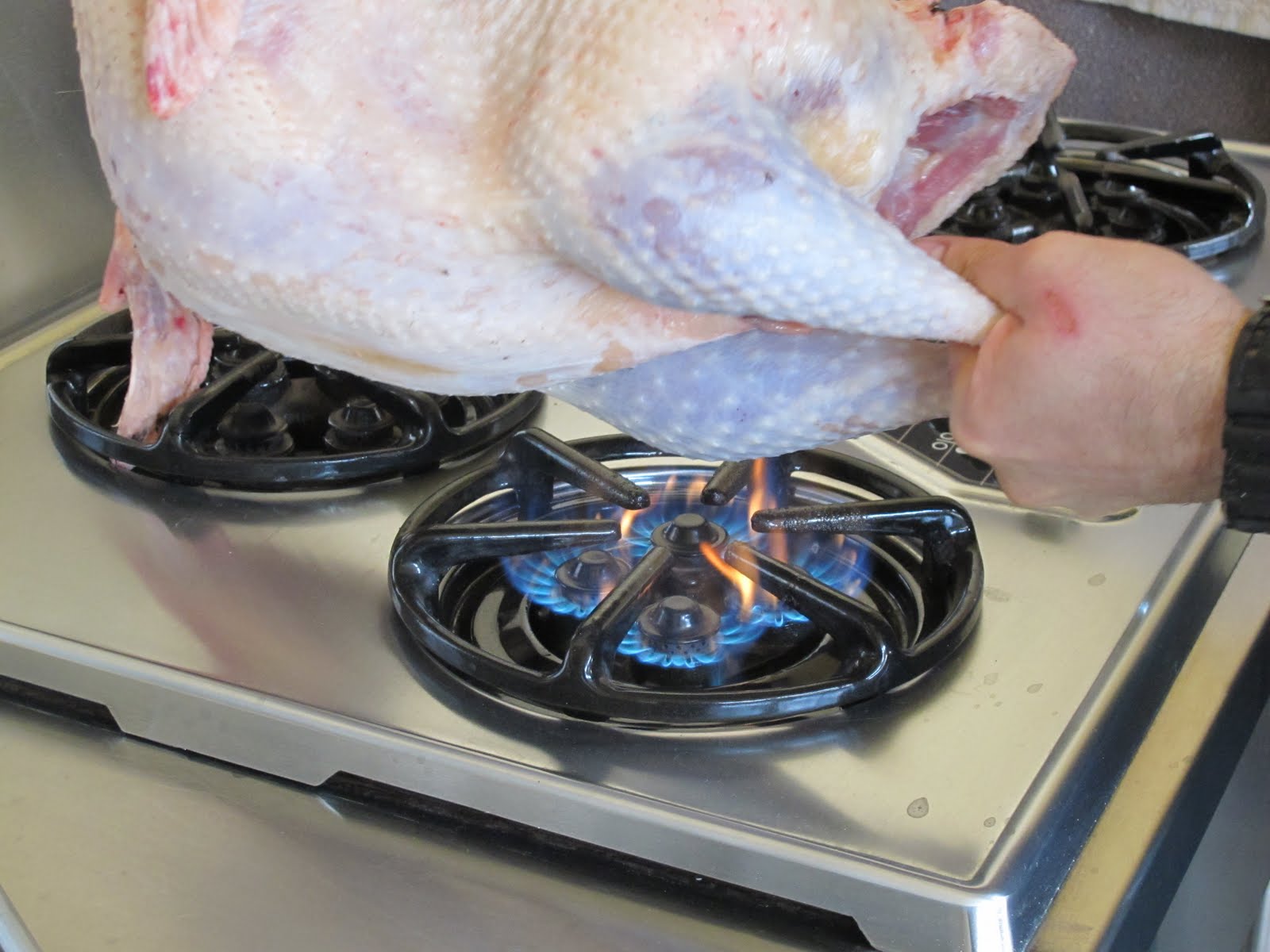
Thanks for finally burning off those pinfeathers. My mom used to burn brown paper in a metal bucket and stick them in it as it burned. This reminds me of what a woman my mom was. No time for being squeamish! Thanks for reminding me of that.
Posted by: Dawn | April 4th, 2011 at 4:17 pm
For me, being humane is not a matter of "more" or "less". Cruelty is cruelty, and killing is killing. So for me, the best way is to consume a vegetarian diet, and have compassion for as many living beings as I can. Your pictures only reinforced the practices we condone by consuming animals. Sorry to sound strident. But let's please stop taking comfort in the thought that "it's OK. I'm really just being less cruel."
Posted by: Bayard | April 4th, 2011 at 4:36 pm
Thank you so much. This was wonderful. I find it interesting when people find the images disturbing. It truly is the circle of life. The sanitized grocery store version is not reality. I would much rather know where my meat comes from.
Posted by: Heather | April 4th, 2011 at 4:53 pm
We love the Black Spanish breed. We had a Tom as a pet for several years. He was well liked around the farm community that we live in. People would stop by to see him. When ever we where out side he loved just being with us and talking to us. He would even come to the back door on the pouch and look in to see if any one was in the kitchen. And a wild hen would stop by from time to time to see him also. After he passed. (a neighbor's dog was out) My husband even raised some turkey chicks. When they saw him they would come running to him and would eat out of his hand.
Posted by: Yvonne | April 4th, 2011 at 5:11 pm
Trish,
You are right. And I apologize to you for my snidely remark. No excuse here, just a bad day.
sorry.
Posted by: iowacowgirl | April 4th, 2011 at 7:19 pm
Spectacular post! May I ask, what do you do with the yolks??
I am truly fascinated!!!
Ms. G
Posted by: Ms. G | April 4th, 2011 at 7:58 pm
Martha you were right. This was a little bit too much for me to wake up to at 5 a.m. and I returned to your blog tonight. It is interesting and I do remember my Mom singing the needles from the turkey on Thanksgiving. Will you be giving these turkeys away or freezing for some summer grilling? I am sure they are delicious!
Posted by: Barbara | April 4th, 2011 at 10:07 pm
Thank you, Martha. I am so grateful to see this. One of the stories my mother told me about my Russian grandmother is how she would clean a chicken and there would be yolks inside. She would use them to make her egg noodles. She also singed the pinfeathers over the burner of the stove too. My grandmother was a gourmet cook but she didn't know it.
Posted by: Carol | April 4th, 2011 at 11:40 pm
Great efforts done by u. i appreciate ur efforts and happy that u have a real concern to protect the world. thats great passion. my sincere wishes are with u
Posted by: jafir shirazi | April 5th, 2011 at 12:04 am
was a vegetarian for like 12 years before i got pregnant five years ago. time to go vegan. thanks for the push. it was really interesting. never knew how eggs formed. cool.
Posted by: chris | April 5th, 2011 at 1:16 am
Martha,This posting was so very informative. We have chickens and a tom turkey, but have just used the chickens for eggs. The tom is just a pet although he has been sad since his Mrs. died a couple of months ago. Now we have way too many roosters and have started incubating our eggs for meat.We have skinned our chickens before, but wanted to pluck the next bunch. So this was extremely useful.Thanks for the great information. Cindy
Posted by: Cindy Freshley | April 5th, 2011 at 2:22 am
You broached this subject tastefully and it opens up that dialogue of how to "respect" your food. I think that so many Americans have lost this vision of how food gets to the table. We throw away so much when in fact we should be using all we can, especially in an economy like this. Martha I want to thank you for being this bold and charismatic with your approach to this subject. I am certain you will get lots of feedback, good and bad. For those of us who were fortunate to grow up in small towns and farms across America, we appreciate you "re-education" to food in the USA, it doesn't just happen! There is a lot of work and preparation that goes into getting food on your plate!
Posted by: Paul Sanchez | April 5th, 2011 at 10:18 am
Martha, I'm sorry I love you and all the things you do "but this is crazy! Now I know why you'r daughter 'Alexa went all vegetarian on you, just the same I am still a great fan of yours. : - )
Posted by: Tracey | April 5th, 2011 at 12:38 pm
I appreciate your dedication to humane butchering, but this was just gross! It's better when your blog is about pleasantries like things growing on the farm, or about excitement, like hob-nobbing at fancy N.Y. parties.
Posted by: Chuck | April 5th, 2011 at 1:20 pm
Hi Martha:
I doubt I would enjoy watching my turkeys go thru that process. Looking at those pictures made me appreciate my supermarket and the local butcher much more. Thank goodness we do not have to do those nasty things anymore plus it is rip roaring hard work. Those feathers are stubborn.
However, it is true that you know what your turkeys were fed and how they lived. For myself, I hope I get a turkey that was raised humane next Thanksgiving. But I will never be checking my farm for one.
Linda
Phila., PA
Posted by: Linda | April 5th, 2011 at 3:10 pm
If we eat meat we should understand the process involved in getting it to our plates. Martha's turkeys had happy lives before they were butchered so I'm sure they will taste all the better for it.
Posted by: Sara | April 5th, 2011 at 3:42 pm
Great article! I really appreciate you helping people understand exactly where their food comes from.
http://reverentoutdoors.blogspot.com/
Posted by: Joel Martyn | April 5th, 2011 at 4:18 pm
This post was very interesting and educational. Thank you for posting it again, Martha. I was disappointed when it was removed last week because I wanted to show it to a few people. Glad it's back! I especially liked seeing how eggs become eggs from the yolk to the eggshell. Always something interesting on your blog. Thanks, Martha!
Posted by: Scott David Smith | April 5th, 2011 at 6:57 pm
Very interesting indeed...found ourselves in the same predicament with our own Bourbon Reds. We started them in July but butchered them anyway in November. They were small but the flavor was superb...we are starting our birds much earlier this year!
Posted by: Kate Moen | April 5th, 2011 at 10:31 pm
Martha,
This post was very upsetting. I was under the impression these turkeys were for breeding purposes, since they were heritage breeds. I remember when the Frenchies visited them last fall after Thanksgiving, and they were still alive. I was so relieved. Since they had escaped the axe back then, I wasn't expecting to find they had been butchered "in cold blood" this spring.
Guess I'll pass on your Thanksgiving dinner invitation this year.
Posted by: Lee | April 5th, 2011 at 11:41 pm
What an interesting blog! My husband and I are trying to live more sustainably on our small horse farm. We started our foray into organic gardening 3 years ago (horse manure is fabulous for it!). We then added a flock of chickens to our farm, just for egg production. We have considered raising and butchering our own poultry, so this blog was very enlightening, particularly with all of the images! I think I will have to find someone local to train me in "poultry butchering" before I try it, however.
Posted by: Chelsea | April 5th, 2011 at 11:55 pm
Fascinating post! Does anyone know what brand of cooktop Pierre is using? Very cool burner design. Any info would be much appreciated.
Posted by: Joe | April 6th, 2011 at 10:09 am
I'm proud of you Martha! Too many people just do not understand their heirtages, and worse, don't even care. How do they think their ancestors, just 75-100 years ago survived? I think we all have it much to easy and have no concept of how to grow and take care of things. It's just too sad that instead of commending you for the wonderful job you do, they want to be ridiculous and bury their heads in the sand. I hate to tell them, but you know the child who hides their eyes and thinks because they can't see you, you can't see them? Grow up already! : - ) Love you Martha! (like a sister!!) Keep up the good work! After some of the above comments, I'll support you even more!! : -)
Posted by: Lynn | April 6th, 2011 at 1:18 pm
Dear Martha, I am a Medical Technologist and so am quite accustomed to blood, body fluids and innards. I found this article to be very informative and educational. Seeing shows about meat processing has made me much more cognizant and respectful of where my food comes from. We all need to get our heads out of the sand! Thank you.
Posted by: Joan | April 6th, 2011 at 3:52 pm
Dear Martha,
“The truth is rarely pure and never simple.” Oscar Wild.
Thank you for this wonderful post, it is a necessity for the new generations like mine to really understand where the food comes from. This nation has become so oblivious about food, food preparations etc, everything now a days is not only already butchered and packaged for us, but also HIGHLY processed. We MUST learn to respect and appreciate where our food comes from.
And as far as the negative comments go, I find them highly disrespectful. I respect your way of life if you wish not to eat meat, however you must respect my way of life as well.
Please remember that Biologically we are omnivorous and our bodies were BORN to process both plants and animals.
Posted by: Vanessa | April 6th, 2011 at 4:48 pm
I believe that you should see this and choose to eat the meat or not, but know where it comes from and how it was treated. For myself, I believe, "Don't eat anything you arent willing to kill yourself."
Posted by: Jayne Rogers | April 6th, 2011 at 6:52 pm
Very interesting and educational. I am considering becoming a vegetarian.
Posted by: Marsha Ann | April 7th, 2011 at 5:55 am
How absolutely fascinating!! I've always wondered how this process took place.
Posted by: David | April 7th, 2011 at 11:40 am
Dear Martha,
How awesome!! I used to help my Mom butcher chickens growing up and after I was married, my Mother-in-law, sister-in-law and I continued butchering our own chickens. My husband and I also raised ducks, geese, guineas and turkeys. We enjoyed them as babies, took care of them through adulthood and some we even let have a "family" and we enjoyed that phase too. But like you said, it's part of the life cycle and we enjoyed them when they reached our plates too. Very interesting; thank you.
Posted by: Esther | April 7th, 2011 at 11:59 am
Posts here made me think but nothing new for me. I raise and sell beef and my family has done it sinw the days when Bison roamed these prairies. In earlier times, the land was not owned by humans here. Think about that.
Posted by: ann | April 7th, 2011 at 12:31 pm
This made me think of my grandmother singeing chickens over a white porcelain kitchen sink with a burning twist of paper and the cold water faucet running. I love how an occasional whiff of that smell will bring back that picture. Is it that this operation is no longer necessary with store-bought chicken?
And the formation of eggs. So interesting! I've never seen that before. However, who really thinks people (and Americans in particular) are so ignorant about how food is produced? I know a lot of people from different circumstances, in the middle of a very large American city, some distance from actual farmland, and none of them live under a rock. Yet this conceit about having to be in touch with the earth/doing it all yourself comes up over and over in these comments. Tedious.
But, what does farming have to do with this so-called "circle of life" or "life cycle" or even the food chain? This is an artificial, man-made system. People select breeds for flavor and the amount of meat produced, raise the livestock, butcher and consume.
Some animals are kept for breeding, some are eaten quickly. A pig is usually slaughtered at 5 months. Chickens don't lay well for very long and how many are kept as pets after they're done? Maybe it's a circle of life if the worms who eat you when you are gone are in turn eaten by the chickens, but come on!
Posted by: JW | April 7th, 2011 at 10:41 pm
I am happy there are people who don't mind doing this.. I prefer being on the eating side..not the slaughtering, it would definitley take some getting use to! However, I would love to know all the meat my family and I consume is organic and home grown. We have our own garden...but still have to frequent the meat department!!
Posted by: Sherri | April 8th, 2011 at 11:05 am
This was a great post! Someday I hope to have chickens and turkeys. Now I just have to convince my husband that we will need to slaughter the birds ourselves! This will be very handy to show him how do-able it is!
Question, could you explain the process of killing the turkeys? If not, I understand. I'm sure it is a bit graphic.
Thanks again!
Posted by: Kaylin | April 8th, 2011 at 12:18 pm
..here they come out of the wood work...God gave us dominion over the earth...how offended he must be when he "hears" some calling his gifts anything other than, well...gifts....very interesting Martha...
Posted by: Monica | April 9th, 2011 at 7:15 am
Hi Martha. This was helpful in solidifying my choice to cease eating mammals and fowl. I love you and find everything you do incredibly educational.
Posted by: david | April 11th, 2011 at 11:38 pm
Very interesting, this didnt make me squeamish at all.
Some of the negative posts though, in my opinion, that are criticizing Martha's choice to butcher these turkeys, shouldnt be here.
Anyhow, love you Martha, hope you had a great weekend, I always enjoy your blog posts, they're informative, the photos are always beautiful, and the captions very descriptive.
Posted by: Tyler | April 17th, 2011 at 6:39 pm
the eggs in process was very educational. i have never processed a turkey, only chickens. never have i seen egg yolks, or unlaid eggs. probably just by chance, but i'm glad you included those pics. thank you!
Posted by: shawna | April 26th, 2011 at 10:55 pm